Emergency Fire Damage Restoration in Little Falls
Emergency fire damage restoration in Little Falls and surrounding areas. IICRC-certified, insurance billing accepted. Call (320) 733-8868.
Fire damage emergency in Little Falls? Call now for emergency service. Our crew responds fast to secure the property and start the recovery.
Smoke moves faster than fire. By the time flames are out, soot has already traveled through your HVAC system, settled into closets two rooms away, and begun etching glass, chrome, and painted surfaces. The first 24 to 48 hours after a fire determine how much of your home is restorable versus how much has to be replaced. Fire and smoke restoration is not a cleaning job. It is a timed, sequenced technical process, and the clock starts the moment the fire department leaves.
What Fire Damage Restoration actually involves
Fire losses leave behind four distinct problems: structural damage from heat and flame, soot and char residue on surfaces, smoke odor embedded in porous materials, and water damage from suppression efforts. Each one requires a different approach, and they all have to be addressed in the right order.
Soot is not uniform. Protein soot from kitchen fires is nearly invisible but produces a powerful rancid odor and bonds tightly to surfaces. Synthetic soot from burning plastics, insulation, or furniture foam is oily and smears if wiped incorrectly. Wet soot from a slow-burning or suppressed fire is the most difficult to remove because it penetrates deeply and stains aggressively. Misidentifying the soot type is one of the most common and costly mistakes in fire cleanup.
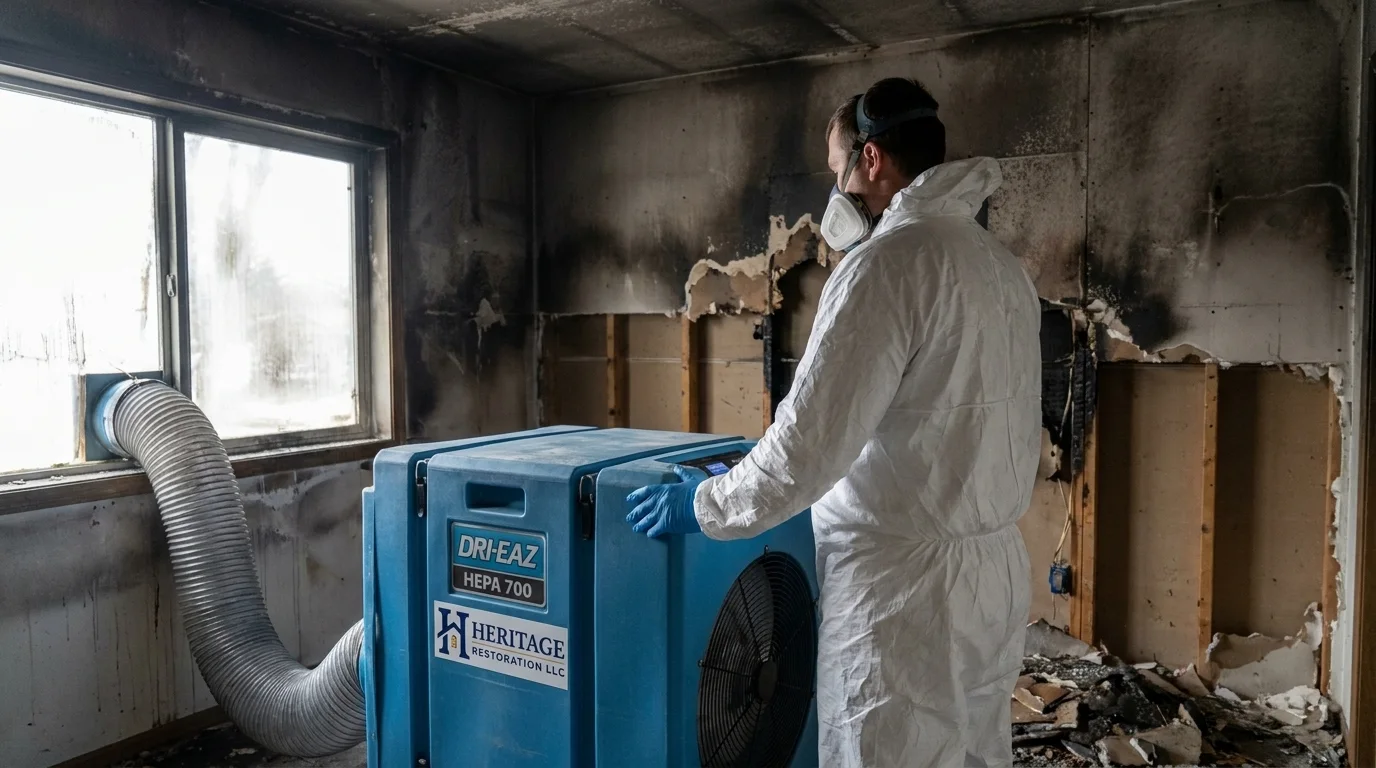
Smoke odor compounds the problem. Smoke particles are microscopic and penetrate drywall, subfloor, insulation, and wood framing. Surface cleaning alone does not eliminate odor. Effective fire and smoke restoration requires thermal fogging or ozone treatment to reach the same spaces the smoke did, including wall cavities and ductwork.
For homes with pre-1978 construction, structural fire damage often disturbs lead paint or asbestos-containing materials during demolition. Heritage Restoration LLC holds EPA Lead-Safe certification, which matters when post-fire repair work involves older building materials.
Our process
-
Soot characterization and scope assessment. Before any cleaning begins, the crew identifies what burned, what type of soot residue is present, and how far smoke has migrated. This determines which cleaning agents, techniques, and containment measures apply. Protein soot, synthetic soot, and wet soot each respond to different chemistry.
-
Stabilization and pack-out. Structurally compromised areas are secured. Contents that can be restored are inventoried and removed for off-site cleaning, a process called pack-out. This protects salvageable belongings from ongoing soot exposure and secondary smoke damage during the restoration work, and it gives adjusters a documented contents inventory.
-
Structural cleaning and controlled demolition. Char, heavily saturated drywall, and unsalvageable materials are removed. Remaining surfaces are cleaned using the appropriate method for the soot type: dry chemical sponges for dry soot, alkaline cleaners for protein residue, and solvent-based products for synthetic residue. Ceilings are cleaned before walls, walls before floors.
-
Odor neutralization. Once surfaces are clean, thermal fogging or ozone treatment is deployed to neutralize smoke odor at the molecular level. Thermal fogging works by dispersing a deodorizing agent as a fine mist that follows the same pathways smoke traveled. Ozone treatment is used in unoccupied spaces and breaks down odor compounds through oxidation. The HVAC system is cleaned and treated separately.
-
Moisture remediation and reconstruction readiness. Suppression water left behind by firefighting efforts is extracted and dried using the same structural drying protocols applied to water damage losses. Moisture readings are documented before any reconstruction begins. Heritage Restoration LLC holds IICRC FSRT (Fire and Smoke Restoration) and IICRC WRT (Water Restoration) certifications, which means both sides of a fire loss are handled under one documented scope.
What separates a good fire damage response from a bad one
The most common failure in post-fire restoration is starting too fast in the wrong direction. Crews that begin wiping soot before identifying the type will smear oily synthetic residue into porous surfaces, permanently staining drywall and wood that could have been cleaned. Protein soot is frequently missed entirely because it is nearly invisible, leaving behind an odor problem that resurfaces after reconstruction.
A second common failure is treating smoke odor as a surface problem. Painting over soot-stained walls without proper cleaning and odor treatment will not seal in the smell permanently. Odor compounds off-gas through new paint within weeks.
Insurance adjusters look for documentation at every stage: pre-cleaning photos, soot type identification notes, moisture readings, a contents inventory, and a written scope that separates structural repair from contents cleaning. A restoration company that cannot produce this documentation creates problems at the claims level that delay your settlement.
Finally, suppression water is almost always underestimated. Firefighting leaves significant moisture in walls, subfloor, and insulation. Skipping drying documentation before reconstruction leads to mold growth inside finished walls within weeks.
What does Fire Damage Restoration cost?
Typical costs for fire damage restoration vary widely based on the size of the affected area, the severity of smoke migration, and whether structural rebuilding is required. Most homeowners pay somewhere in the ranges below for the restoration phase alone, not including full reconstruction.
| Scenario | Typical industry range |
|---|---|
| Single room, limited smoke spread | $3,000 to $8,000 |
| Multi-room smoke damage, no structural loss | $8,000 to $20,000 |
| Partial structural loss with pack-out | $20,000 to $50,000 |
| Whole-home fire with reconstruction | $50,000 to $150,000+ |
| Contents cleaning and pack-out only | $2,000 to $10,000 |
| HVAC cleaning and odor treatment | $800 to $3,500 |
These are typical industry figures. Every fire loss is different, and Heritage Restoration LLC provides a written scope of work before any work begins. Homeowners insurance typically covers fire damage restoration, including smoke cleanup, odor treatment, and contents pack-out, subject to your policy’s deductible and coverage limits.
Seasonal and regional considerations
In central Minnesota, fire losses in winter create a compounding problem. Homes are sealed tight for heating season, which concentrates smoke odor and slows ventilation-based drying. Suppression water in below-freezing conditions can freeze inside wall cavities before it is extracted, complicating both moisture remediation and structural assessment. Little Falls and the surrounding Morrison County area also has a significant share of older housing stock, including homes built in the mid-20th century with plaster-and-lath construction and older insulation types that behave differently under fire and water exposure than modern materials.
Wood-burning appliances are common in rural properties throughout the region, and chimney fires are a frequent cause of attic and roof losses that look contained from below but have spread farther than visible char suggests.
Service area
Heritage Restoration LLC is based in Little Falls, MN and serves Morrison County and the surrounding region. The city-specific fire damage restoration pages for neighboring communities link back here for the full technical overview of the process.
If you are looking at smoke stains on your ceiling and the smell of char is still in the air, the window for protecting salvageable materials is closing. Call Heritage Restoration LLC at (320) 733-8868 to begin smoke and soot removal and get a written scope before secondary damage adds to the loss.
Frequently Asked Questions
What is the difference between protein soot and synthetic soot, and why does it change how cleanup works?
Does homeowners insurance cover fire damage restoration?
Why does my home still smell like smoke after the visible soot has been cleaned?
How much of my home's contents can actually be restored after a fire?
How long does fire and smoke restoration typically take from start to finish?
Looking for the best fire damage restoration company in Little Falls?
Heritage Restoration LLC provides licensed and insured fire damage restoration in Little Falls, MN and the surrounding area, and has served local property owners since 2023. We answer calls 24/7 — call (320) 733-8868 for immediate help.
Need Fire Damage Restoration now?
We respond 24/7 across Little Falls and surrounding MN cities.
Related Coverage
- Our Restoration Services
- Contact Heritage Restoration LLC
- Emergency Fire Damage Restoration in Albany
- Emergency Fire Damage Restoration in Avon
- Emergency Fire Damage Restoration in Baxter
- Emergency Fire Damage Restoration in Brainerd
- Emergency Fire Damage Restoration in Elmdale
- Emergency Fire Damage Restoration in Flensburg
- Emergency Fire Damage Restoration in Foley
- Emergency Fire Damage Restoration in Fort Ripley
- Emergency Fire Damage Restoration in Harding
- Emergency Fire Damage Restoration in Long Prairie
- Emergency Fire Damage Restoration in Pierz
- Emergency Fire Damage Restoration in Randall
- How To Choose a Restoration Company in Little Falls (Without Getting Burned)
- The Fire Damage Restoration Process, Explained