
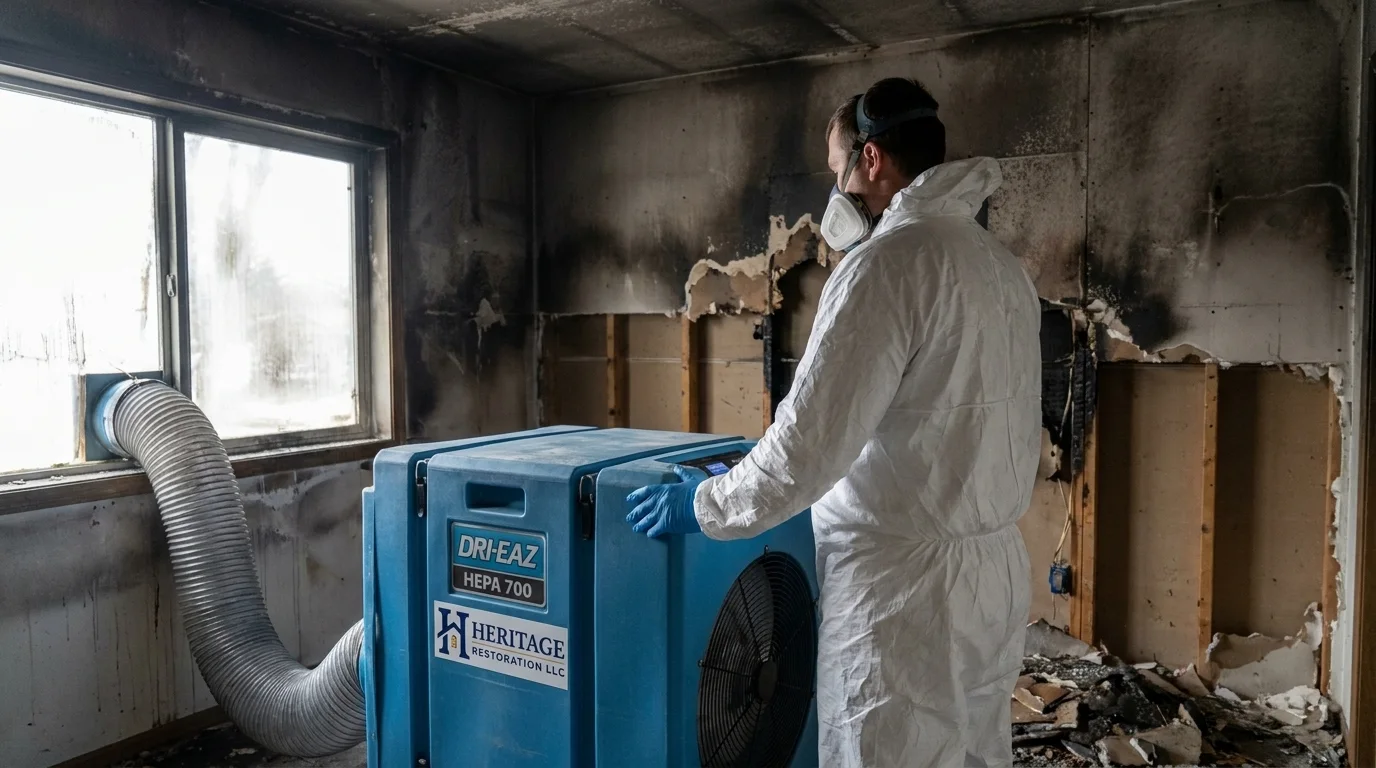
Emergency Fire Damage Restoration in Albany
Emergency fire damage restoration in Albany, MN. IICRC-certified, insurance billing accepted. Call (320) 733-8868.
Our IICRC-certified technicians are dispatched from our Little Falls, MN headquarters and are typically on-site in Albany within 60 minutes of your call.
Fire damage emergency in Albany? Call now for emergency service. Our crew responds fast to secure the property and start the recovery.
Albany sits in Stearns County, where long winters, older agricultural-era housing stock, and the kind of tight-knit small-town construction that predates modern fire-resistive codes all shape what happens after a house fire. When smoke has worked its way into the wall cavities of a wood-framed farmhouse or a mid-century bungalow on the edge of town, the cleanup is rarely as simple as it looks from the curb. Heritage Restoration LLC responds to fire damage calls in Albany with an IICRC FSRT-certified crew and the equipment to handle both the visible char and the invisible residue that travels far beyond the burn zone.
Why Albany Properties Face Particular Fire Damage Challenges
Much of Albany’s residential housing was built during an era when balloon-frame construction was standard. In that framing style, wall cavities run continuously from the basement to the attic with no fire-blocking between floors. After a fire, that means smoke, soot, and combustion gases can travel vertically through the entire wall assembly, depositing residue in spaces that show no outward sign of damage. A kitchen fire that chars the cabinets may leave a fine protein film on the attic sheathing two stories up.
Stearns County winters add another layer of complexity. Homes in Albany are tightly sealed for much of the year, which limits natural ventilation during restoration. Negative-pressure containment and mechanical air scrubbing become especially important when outdoor temperatures make opening windows impractical. Heating systems, which run hard through a Minnesota winter, can circulate smoke particles through ductwork within minutes of a fire, spreading contamination to rooms that never saw flames.
Our Fire Damage Restoration Process in Albany
The work starts with a structured assessment, not a sales pitch. Before any cleaning begins, the crew documents the loss with photographs and moisture readings, maps the smoke migration path, and identifies any materials that need to be removed rather than restored. That documentation matters later when the insurance claim is being processed.
Content and structural cleaning follow different protocols depending on residue type. Dry soot from fast-burning fires brushes differently than the sticky, wet residue left by slow smoldering fires or burning synthetic materials. Protein residue from kitchen fires is nearly invisible but carries a persistent odor that returns if it is not chemically neutralized. The right cleaning agent and method depend on what burned, not just where the fire was.
Odor control is not a final step; it runs parallel to cleaning. Thermal fogging, hydroxyl generation, and ozone treatment each have appropriate applications, and the choice depends on the materials present and the occupancy status of the home. Once structural surfaces are clean and readings confirm residue levels are within acceptable ranges, any necessary repairs, from replacing drywall to refinishing trim, are scoped and scheduled.
Reaching Albany from Little Falls
Heritage Restoration’s base in Little Falls puts Albany within a straightforward drive south on U.S. Highway 10 and then west on State Highway 238, a route that stays clear in most conditions outside of significant winter weather events. Albany is a compact community, and most addresses in town are reachable quickly once the crew is on the road. For scheduling and response, call (320) 733-8868 directly.
Albany Insurance Coordination
Fire claims in Minnesota typically involve an adjuster visit before or during the early stages of restoration. Heritage Restoration documents the loss in a format that supports the claims process: itemized scope of work, photographs tied to specific areas of the home, and a clear record of what was cleaned versus what was removed. That documentation reduces back-and-forth with carriers and helps avoid disputes over scope later in the project.
If your home was built before 1978, the EPA Lead-Safe certification the crew carries is relevant here. Lead paint disturbed during fire damage repairs in older Albany homes requires specific handling procedures, and some carriers ask for documentation that lead-safe practices were followed before closing out a claim.
Local Note
Albany’s older homes often have plaster-and-lath interior walls rather than drywall. Plaster is dense and absorbs smoke odor compounds differently than paper-faced gypsum board. It is also more likely to survive a fire structurally intact, which is good news for preservation but means the cleaning process takes longer. Plaster cannot simply be replaced the way drywall can; it has to be cleaned in place, and that requires more dwell time with the right chemical agents. Crews working in Albany’s older housing stock plan for that extra time rather than treating every wall surface the same way.
If your Albany home has been damaged by fire, the sooner the assessment begins, the more options you have. Smoke residue becomes harder to remove as it oxidizes and bonds to surfaces over time, and secondary damage from firefighting water compounds quickly in a closed structure. Call Heritage Restoration LLC at (320) 733-8868 to schedule an assessment and start the process of getting your home back.
Fire Damage Restoration in Albany: Service Coverage
Frequently Asked Questions
How fast can you arrive for fire damage restoration in Albany?
How does Albany's cold climate affect the fire damage restoration timeline?
Are Albany homes with older balloon-frame construction harder to restore after a fire?
Does the presence of lead paint in older Albany homes affect how fire damage repairs are handled?
What does smoke remediation actually involve in a Stearns County home with plaster walls?
How does Heritage Restoration coordinate with insurance adjusters on Albany fire claims?
Fire Damage Restoration response in Albany
Most Albany calls see a technician on-site within 60 minutes from our Little Falls headquarters.