
Emergency Fire Damage Restoration in Long Prairie
Emergency fire damage restoration in Long Prairie, MN. IICRC-certified, insurance billing accepted. Call (320) 733-8868.
Our IICRC-certified technicians are dispatched from our Little Falls, MN headquarters and are typically on-site in Long Prairie within 60 minutes of your call.
Fire damage emergency in Long Prairie? Call now for emergency service. Our crew responds fast to secure the property and start the recovery.
Long Prairie winters are no gentle thing. When temperatures drop hard across Todd County and a house fire breaks out in the middle of a January cold snap, the aftermath is more complicated than the fire itself: smoke odor locks into frozen surfaces, water from suppression efforts freezes in wall cavities before it can be extracted, and the structural damage can be hidden under ice before anyone realizes the full scope. Heritage Restoration LLC holds IICRC FSRT (Fire and Smoke Restoration) certification and responds to fire damage calls throughout Long Prairie and the surrounding Todd County area.
Why Long Prairie Properties Face Distinct Fire Damage Challenges
Long Prairie sits in central Minnesota, where the climate swings from humid summers to prolonged subzero winters. That range matters after a fire. In warmer months, smoke residue and soot settle deep into porous materials quickly, and the humidity accelerates corrosion on metal fixtures and electronics. In winter, suppression water can freeze inside wall cavities and under subflooring before drying equipment ever arrives, creating secondary damage that is easy to miss on initial assessment.
The housing stock in Long Prairie skews older, with a meaningful share of homes built in the mid-twentieth century or earlier. Those homes often feature plaster-and-lath interior walls rather than modern drywall. Plaster holds smoke odor differently: the surface may wipe clean while the lath behind it has absorbed years of air and now carries char and soot deep into the structure. Older homes in this area also commonly have knob-and-tube or early-generation wiring, which can complicate the investigation of fire origin and affect how restoration crews approach wall openings.
Local utility infrastructure also plays a role. Homes in and around Long Prairie that rely on propane or fuel oil rather than natural gas carry a different fire risk profile, and post-fire assessments need to account for the storage and delivery systems specific to rural and semi-rural Todd County properties.
Our Fire Damage Restoration Process in Long Prairie
The first step on any fire loss is a thorough scope assessment before any cleaning begins. Soot is not uniform: wet smoke residue from a slow, smoldering fire behaves completely differently from the dry, powdery residue left by a fast-burning structural fire. Getting that wrong means using the wrong cleaning chemistry and making the damage worse.
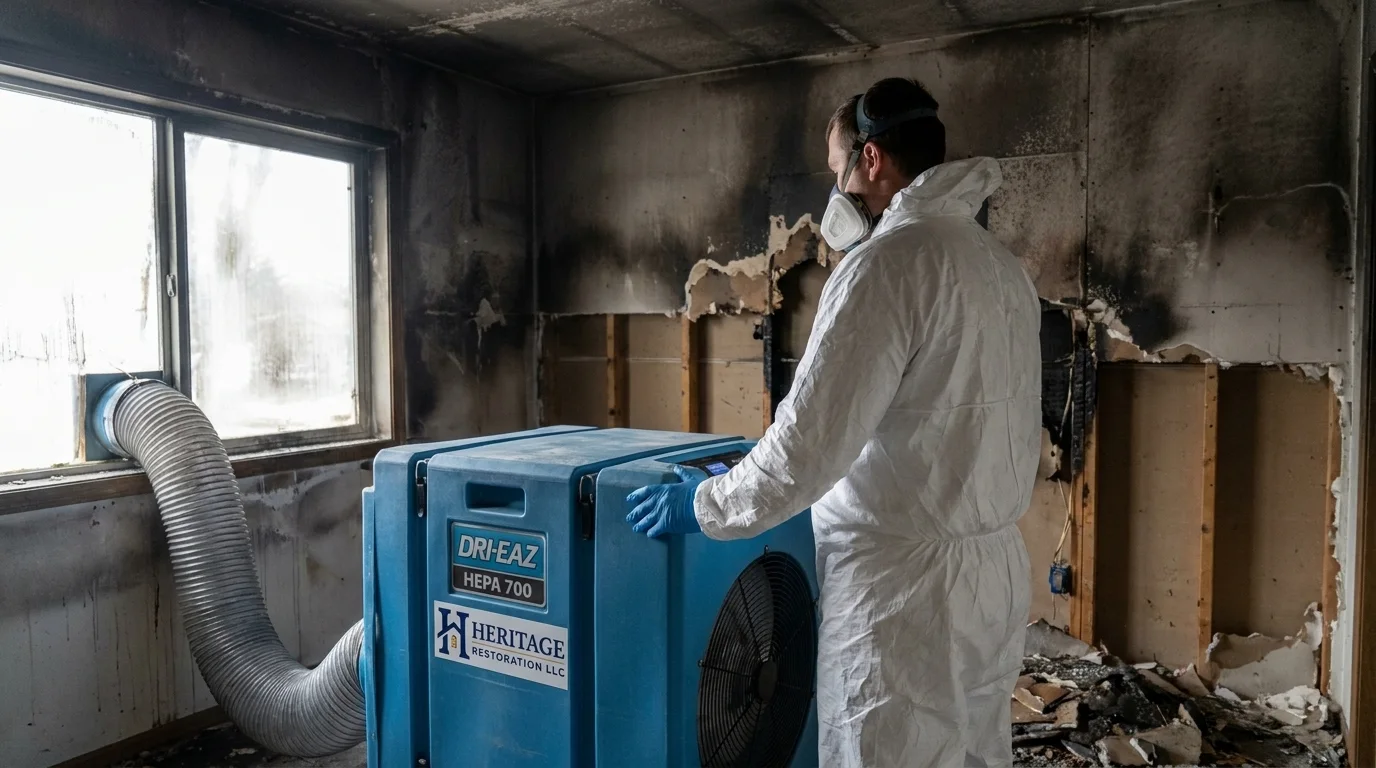
From there, the process moves through controlled demolition of unsalvageable materials, HEPA-filtered air scrubbing to pull airborne particulate out of the structure, and targeted odor neutralization using thermal fogging and hydroxyl generation where appropriate. Structural drying follows if suppression water is present, using equipment and protocols aligned with the IICRC S500 standard.
For older Long Prairie homes with plaster walls, we probe beyond the surface before declaring materials salvageable. Plaster that reads clean visually can still off-gas smoke odor for months if the lath behind it was not properly treated. That extra step adds time up front and saves a callback later.
EPA Lead-Safe certification is part of our credential set, which matters in pre-1978 homes throughout Todd County. Disturbing painted surfaces during fire cleanup without lead-safe protocols is a compliance issue and a health concern, and it is not something to skip because a job is already stressful.
Reaching Long Prairie from Little Falls
Heritage Restoration LLC is based in Little Falls, which sits roughly 25 miles south of Long Prairie along U.S. Highway 10. That route is a direct, well-maintained corridor that keeps travel time predictable in most conditions. Winter is the exception: when a storm system moves through central Minnesota, Highway 10 between Little Falls and Long Prairie can slow significantly, and we account for that honestly when coordinating arrival. Call us at (320) 733-8868 to discuss scheduling and get a realistic estimate of when a crew can be on-site.
Insurance Coordination for Long Prairie Fire Claims
Fire losses in Todd County typically move through standard homeowner’s insurance channels, but the documentation requirements are real and the process is not always intuitive when you are standing in a smoke-damaged house. Heritage Restoration works alongside your adjuster, providing itemized scope documentation, moisture and soot readings, and photo documentation of affected materials. We do not bill on your behalf, but we structure our documentation so that your carrier has what it needs to process the claim accurately.
If your policy includes additional living expense coverage, understanding that timeline early matters, because fire restoration in a structurally affected home can run weeks, not days.
Local Note
In Todd County, a notable share of residential properties outside the city core use well water rather than municipal supply. After a fire, suppression water drawn from a tanker or a rural hydrant can have different mineral content than city water, and that affects how residue behaves on surfaces and how quickly secondary corrosion develops on metals. It is a small detail, but it is the kind of thing that changes how we approach cleaning chemistry on a rural Long Prairie property versus a home on city water closer to downtown.
Fire Damage Restoration in Long Prairie: Service Coverage
Frequently Asked Questions
How fast can you arrive for fire damage restoration in Long Prairie?
How quickly can Heritage Restoration reach Long Prairie from Little Falls for a fire damage call?
Does the age of Long Prairie's housing stock affect how fire and smoke restoration is handled?
Does a fire in a Long Prairie home during winter create additional restoration complications?
How does smoke odor removal actually work in a structurally affected Long Prairie home?
What should I expect from the insurance documentation process after a fire loss in Long Prairie?
Fire Damage Restoration response in Long Prairie
Most Long Prairie calls see a technician on-site within 60 minutes from our Little Falls headquarters.
Nearby & Related
- Emergency Fire Damage Restoration in Little Falls
- Restoration Services in Long Prairie
- Roofing Installation and Replacement in Long Prairie
- Emergency Water Damage Restoration in Long Prairie
- Emergency Fire Damage Restoration in Albany
- Emergency Fire Damage Restoration in Avon
- Contact Heritage Restoration LLC