
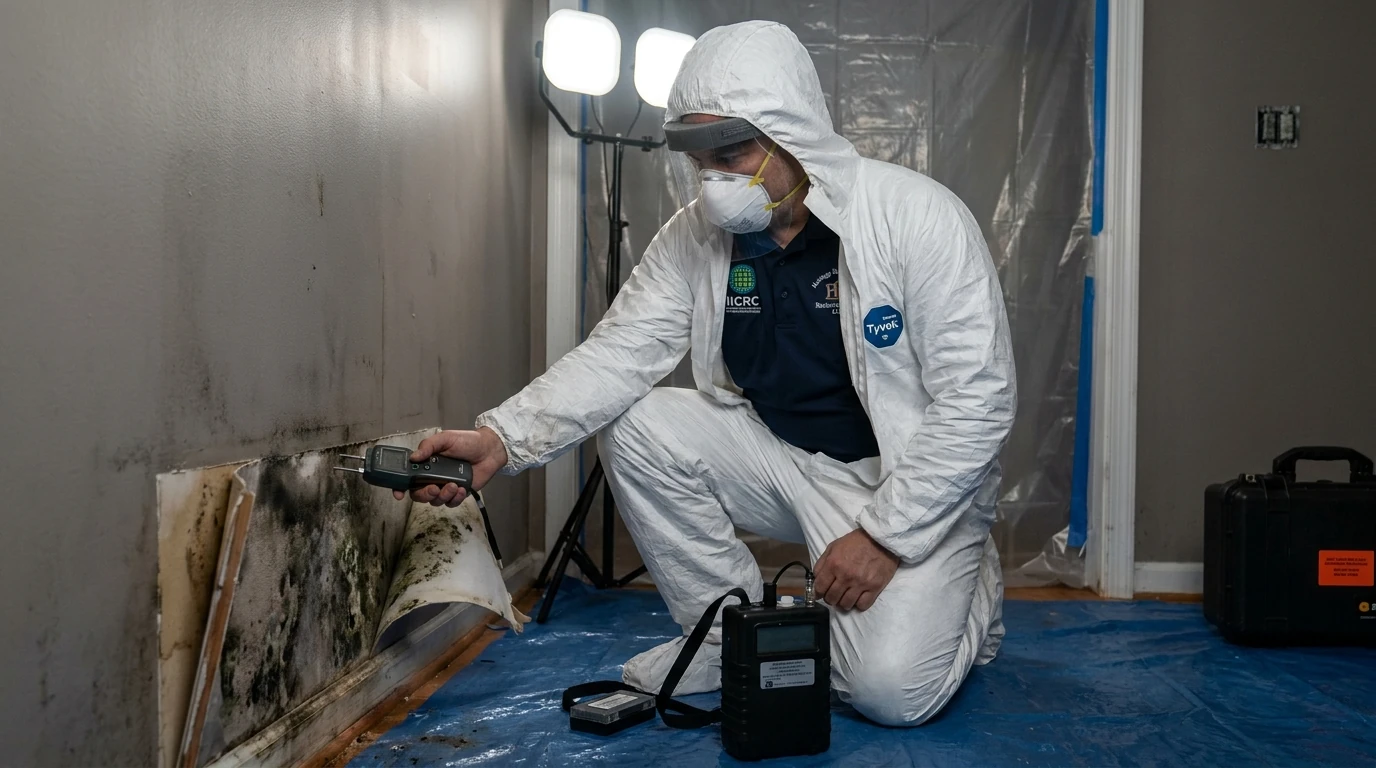
If you’re noticing a musty smell, a soft spot on drywall, or unexplained allergy symptoms that ease up when you leave the house, you likely have mold growing somewhere you can’t see it. The most common hiding spots are behind walls near plumbing, under flooring after a slow leak, inside HVAC ductwork, and in crawl spaces or basements where humidity sits unchecked. Hidden mold doesn’t resolve on its own, and in a Little Falls winter, condensation inside exterior walls can feed it for months before anyone spots a visible patch. The good news: your nose, your eyes, and a few diagnostic steps can usually tell you something is wrong well before the problem becomes a full remediation job.
7 Signs Mold Is Growing Somewhere You Can’t See
- A persistent musty or earthy smell that’s strongest in one room, closet, or near a specific wall, even after cleaning.
- Discoloration or a faint yellow, brown, or black stain on drywall, baseboards, or ceiling tiles, especially in a ring or blotchy pattern.
- Peeling, bubbling, or cracking paint and wallpaper, which often means moisture is trapped behind the surface.
- Warped or soft flooring, particularly near exterior walls, bathrooms, or anywhere a pipe runs.
- Condensation on windows or cold wall surfaces that shows up repeatedly, especially during Minnesota’s cold months when indoor humidity gets trapped against exterior walls.
- Worsening allergy or respiratory symptoms at home that improve when you’re away, such as a stuffy nose, headaches, throat irritation, or a persistent cough.
- A known water event you never fully resolved, like a slow roof leak, a sump pump that ran dry during a storm, or a dishwasher that overflowed last spring. Mold can colonize within 24 to 48 hours of sustained moisture, so even a leak that seemed minor at the time can leave a problem behind drywall or subfloor.
What To Do First
Start by narrowing down where the smell or symptom is strongest. Walk the house room by room with the HVAC off so you’re not circulating odor from somewhere else. Check the usual culprits: under sinks, around toilet bases, behind the washing machine, in the basement near the foundation wall, and in any area that’s flooded or leaked in the past few years. A simple moisture meter (available at most hardware stores for under $30) can tell you if a wall or subfloor is reading wet even when the surface looks dry. If you find a stain, press on the surrounding material. Drywall that’s soft or crumbly, or wood that flexes or feels spongy, has likely been wet long enough for mold to take hold underneath.
If you can access the suspect area safely, such as a crawl space or basement wall, a flashlight and a close look for fuzzy texture, speckled discoloration, or white thread-like growth will usually confirm what you’re smelling. Take photos as you go. If you end up needing a professional or filing an insurance claim later, dated photos of the progression are useful documentation.
What Not To Do
- Don’t paint over a stain and hope it goes away. Paint seals in moisture and mold, and the smell and growth typically return within weeks.
- Don’t rely on bleach on porous materials like drywall, subfloor, or wood framing. Bleach can lighten surface staining but won’t kill mold growing into the material, and it adds moisture that can make the problem worse.
- Don’t cut into walls or pull up flooring without a plan if you suspect widespread growth. Disturbing a mold colony without containment can spread spores into the rest of the house through the air.
- Don’t ignore a musty smell because you can’t see anything. Smell is often the earliest and most reliable sign, especially for growth inside wall cavities or under flooring where nothing is visible yet.
- Don’t skip checking the source. Treating visible mold without finding and fixing the moisture behind it (a leaky supply line, poor grading outside, a bathroom fan that doesn’t vent outdoors) means the growth will come back.
When To Call a Professional
Small, isolated surface mold on a non-porous surface, like a shower tile grout line, is generally something a homeowner can clean up with household products and good ventilation. The threshold shifts once growth is on a porous material (drywall, insulation, wood framing, carpet padding), covers more than a couple square feet, or you can smell it but can’t locate it. At that point, air currents and foot traffic are already spreading spores, and opening up the wall yourself risks making exposure worse rather than better.
A professional mold inspection typically includes moisture mapping with a meter or thermal camera, a visual and sometimes air-quality assessment, and identification of the moisture source, not just the visible growth. Heritage Restoration LLC handles mold remediation for homes and buildings around Little Falls, and containment, negative air pressure, and HEPA filtration during removal follow the industry-standard IICRC S500 guidelines for moisture and mold damage. If you’re dealing with an older Little Falls home with a stone or block foundation, or a newer build where a bathroom exhaust fan was never vented properly to the exterior, those structural quirks often explain why mold keeps returning even after a DIY cleanup.
What the Remediation Process Looks Like
Once a problem area is confirmed, remediation generally follows a sequence: contain the affected area to stop spore migration, remove and dispose of materials that can’t be cleaned (drywall, insulation, carpet padding), clean salvageable structural materials with antimicrobial treatment, and run air scrubbers or dehumidifiers until moisture readings return to normal. The timeline depends heavily on how long the moisture source went unaddressed and how far it traveled behind the wall or under the floor. A contained bathroom leak caught within a week or two might be a short job. A crawl space that’s held standing moisture all winter is a longer one, because the growth has had time to establish in framing and subfloor, not just surface material.
Fixing the moisture source is part of the job, not a separate step. A remediation crew that removes mold but doesn’t address the plumbing leak, grading issue, or ventilation gap that caused it is setting the homeowner up for a repeat visit.
If you’ve spotted one or more of these signs and you’re not sure whether it’s something to handle yourself or something that needs a closer look, Heritage Restoration LLC can walk through the affected area with you and explain what’s actually going on before any work starts. Call (320) 733-8868 to talk through what you’re seeing and smelling.