
Mold Remediation in Little Falls
Mold remediation in Little Falls and surrounding areas. IICRC-certified, insurance billing accepted. Call (320) 733-8868.
Mold doesn’t always announce itself with a visible patch on the drywall. More often it starts as a musty smell in a closet, a faint discoloration behind a baseboard, or a family member’s allergies flaring up every time the furnace kicks on. By the time mold is visible on a wall surface, colonies have typically already spread through the wall cavity, insulation, or subfloor where you can’t see them. Heritage Restoration LLC’s mold remediation work in Little Falls is built around finding that hidden spread, not just the stain you noticed.
What mold remediation actually involves
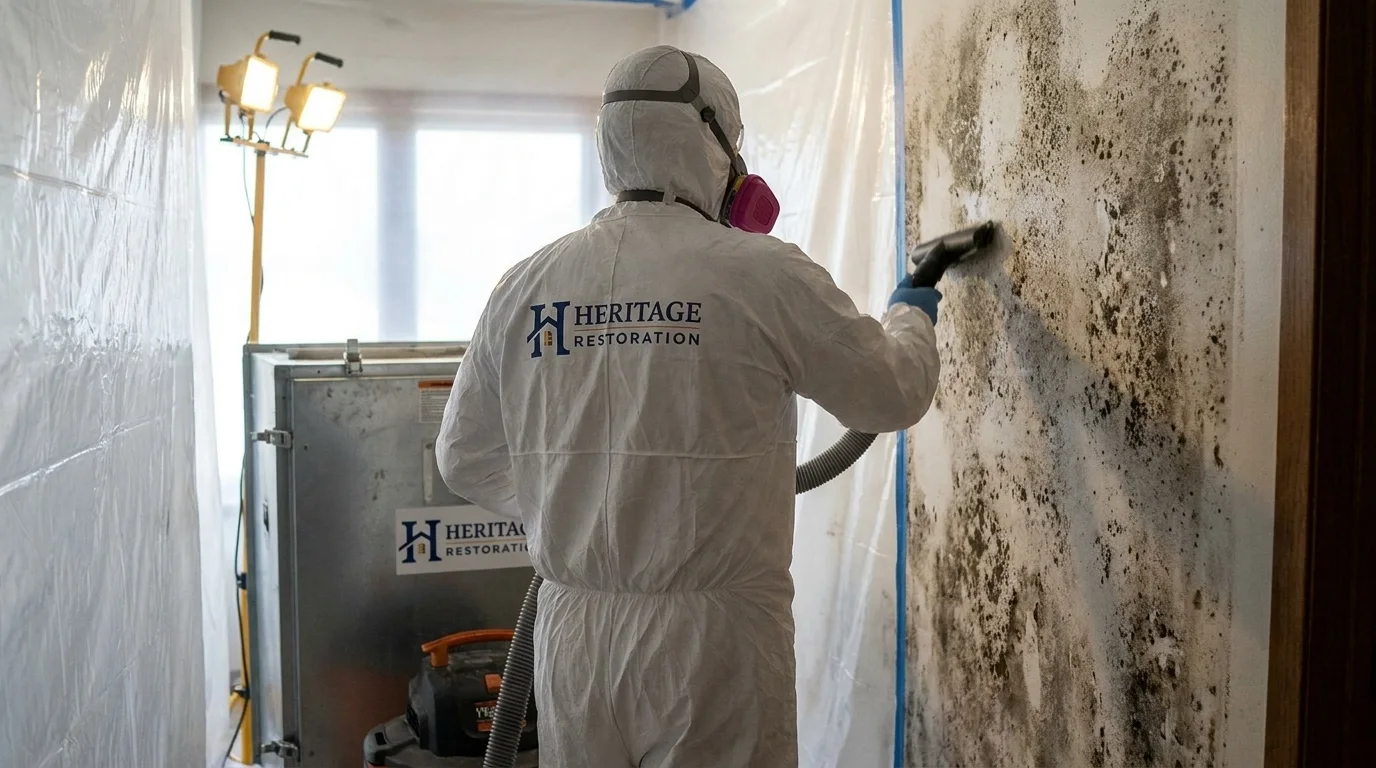
Mold remediation is different from a basic cleaning job. It starts with identifying the moisture source, because treating mold without stopping the water or humidity feeding it just buys you a repeat visit in a few months. From there, the work typically involves sealing off the affected area with physical containment, running negative air machines with HEPA filtration to keep spores from migrating to clean parts of the house, removing and bagging contaminated porous materials (drywall, insulation, sometimes subfloor), and treating remaining structural surfaces with antimicrobial agents. Depending on the square footage and how far the colony has spread into framing, a single-room job might run a few days; a basement or crawlspace with long-term moisture exposure can take longer. Our team holds IICRC AMRT mold certification, and we follow IICRC S520 guidelines for containment and clearance on every job.
Our process
- Inspection and moisture mapping. We use moisture meters and, where warranted, a borescope to check wall cavities before cutting anything open, so the scope reflects what’s actually happening, not just what’s visible.
- Containment setup. Plastic sheeting, negative air pressure, and sealed entry points isolate the work area so spores don’t spread to bedrooms, HVAC returns, or the rest of the home during demolition.
- Air sampling. Baseline air samples (and sometimes surface tape lifts) get sent to a third-party lab so we have a documented starting point and a target for clearance.
- Remediation and HEPA filtration. Contaminated materials are removed, surfaces are treated, and HEPA air scrubbers run continuously to pull spores and fine particulate out of circulation.
- Clearance testing. A post-remediation air sample confirms levels have returned to normal before containment comes down and reconstruction begins.
What separates a good mold remediation response from a bad one
The most common mistake is skipping containment to save time. Without it, disturbing mold during removal can push spore counts higher in untouched rooms than they were before anyone started. Another frequent miss is treating the symptom and ignoring the source: painting over a stain or running a dehumidifier without finding the plumbing leak or grading issue behind it just delays the next outbreak. Adjusters reviewing mold claims generally want to see documented moisture readings, photos of the affected cavity before demolition, and lab-verified clearance testing, not just a before-and-after photo. Hidden mold inside wall cavities after a water loss is also a common point of dispute, which is why we open up and inspect rather than assume a surface-dry wall is clear underneath.
What does mold remediation cost?
Costs vary with the size of the affected area, how far mold has spread into framing or ductwork, and whether air quality testing and clearance sampling are part of the scope. Every loss is different, and Heritage Restoration LLC provides a written scope of work before any remediation begins so there are no surprises once walls are opened. Homeowners insurance typically covers mold remediation when the mold resulted from a covered water event, such as a burst pipe, but it often excludes mold from long-term neglect or unresolved humidity issues, so coverage should be confirmed with your carrier early.
| Scenario | Typical range |
|---|---|
| Small bathroom or closet, surface mold | $500 - $1,500 |
| Single room with wall cavity involvement | $1,500 - $4,000 |
| Basement or crawlspace, moderate spread | $3,000 - $7,500 |
| Whole-house HVAC contamination | $5,000 - $10,000+ |
| Air quality testing and clearance sampling | $300 - $800 |
Seasonal & regional considerations
Central Minnesota’s humid summers and the long stretch of snowmelt each spring create ideal conditions for mold in basements, crawlspaces, and older homes with limited ventilation. Houses near the Mississippi and Little Falls Dam corridor tend to carry higher ambient moisture, and many homes in the area still have original basement construction without modern vapor barriers. Winter brings its own version of the problem: sealed-up homes with poor attic ventilation can trap condensation that feeds mold growth in spaces nobody checks until spring.
Service area
Heritage Restoration LLC provides mold remediation to Little Falls and the surrounding communities throughout central Minnesota, including homes along the river corridor and the older housing stock common to the area’s established neighborhoods.
If you’re smelling something musty, seeing discoloration spread across a wall, or just had a water event you’re worried wasn’t fully dried, request an air quality test from Heritage Restoration LLC (license #BC807677) before the problem gets harder, and more expensive, to contain. Call (320) 733-8868 to schedule an inspection.
Frequently Asked Questions
Does homeowners insurance cover mold remediation?
What level of mold remediation requires containment under IICRC S520?
Can mold come back after remediation if the moisture source isn't fixed?
Do I need air quality testing before and after mold remediation?
What should I do while waiting for a mold remediation crew to arrive?
Looking for the best mold remediation company in Little Falls?
Heritage Restoration LLC provides licensed and insured mold remediation in Little Falls, MN and the surrounding area, and has served local property owners since 2023. We answer calls 24/7 — call (320) 733-8868 for immediate help.
Need Mold Remediation now?
We respond 24/7 across Little Falls and surrounding MN cities.
Related Coverage
- Our Restoration Services
- Contact Heritage Restoration LLC
- Restoration Services in Albany
- Restoration Services in Avon
- Restoration Services in Baxter
- Restoration Services in Brainerd
- Restoration Services in Elmdale
- Restoration Services in Flensburg
- Restoration Services in Foley
- Restoration Services in Fort Ripley
- Restoration Services in Harding
- Restoration Services in Long Prairie
- Restoration Services in Pierz
- Restoration Services in Randall
- How To Choose a Restoration Company in Little Falls (Without Getting Burned)
- How To Test for Mold in Your Home (DIY Kits vs a Pro Inspection)
- 7 Signs You Have Hidden Mold (and What To Do Next)