
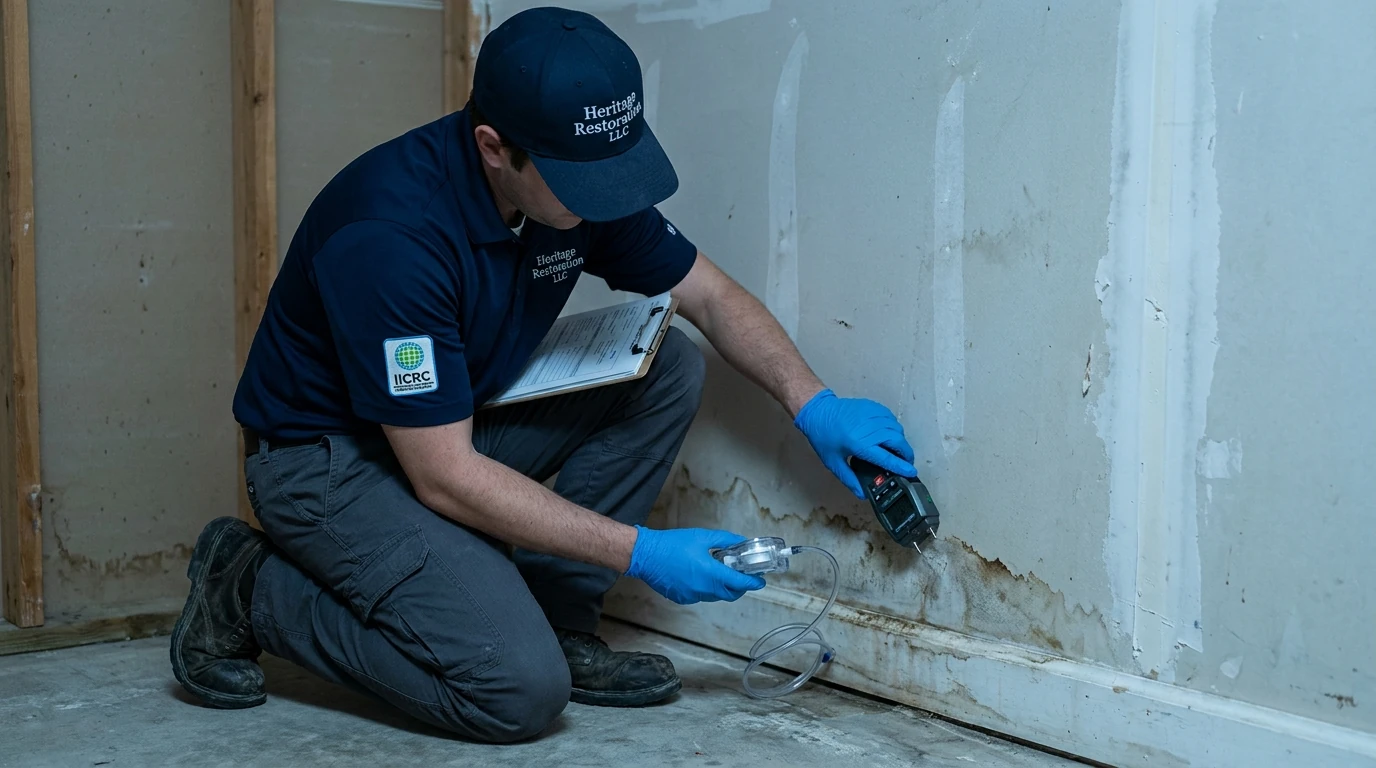
If you’re looking at a dark spot on a wall or basement joist in Little Falls and wondering whether to grab a mold test kit or call someone, here’s the short answer: a DIY kit can tell you that mold spores are present in the air or on a surface, but it usually can’t tell you where the mold is coming from, how far it’s spread, or whether it’s a type that matters for your health. A professional inspection adds moisture mapping, visual assessment of spaces you can’t easily see into, and lab analysis that identifies species. Which one you need depends on what you’re trying to find out, and why.
The Situation: A Stain, a Smell, or a Health Concern
Most people start looking into mold testing for one of three reasons. There’s a visible stain or fuzzy growth on drywall, trim, or a basement wall. There’s a musty smell, often strongest near a crawlspace hatch, behind a washing machine, or in a finished basement that’s taken on water at some point. Or someone in the house has started having allergy-like symptoms (sinus irritation, coughing, headaches) that seem to ease up when they’re away from home.
Little Falls homes built from the mid-1900s through the 1980s often have block or poured concrete basements with less moisture control than newer construction, and central Minnesota’s humid summers combined with snowmelt and spring rain put real pressure on foundations and crawlspaces. Add a sump pump that’s not keeping up, a slow leak around a basement window well, or condensation on cold pipes, and you’ve got the conditions mold needs: moisture, a food source like wood or drywall paper, and time. Mold can begin colonizing damp material in as little as 24 to 48 hours, which is faster than most people expect.
What a DIY Mold Test Kit Actually Tells You
Most kits sold at hardware stores fall into two categories: a settling plate (a petri dish you leave open in a room for a set number of hours, then seal and wait to see what grows) or a swab kit (you wipe a visible spot and send it to a lab). Both have real limits:
- A settling plate tells you mold spores are in the air, which is true in almost every home, even healthy ones. Mold spores are everywhere outdoors and drift inside constantly. A positive result doesn’t confirm an active problem indoors.
- A swab test on a visible stain can usually confirm “yes, that’s mold,” but it won’t tell you what’s happening behind the wall or under the flooring where the moisture source actually lives.
- Neither type of kit does moisture mapping, meaning neither one tells you whether the material behind a stain is still wet, how far the damp area extends, or where the water is coming from.
If what you want to know is simply “is this spot mold or something else,” a basic swab-and-send kit can be a reasonable first step. If what you actually need to know is “how bad is this and where is the moisture coming from,” a kit alone won’t get you there.
What a Professional Inspection Adds
A mold inspection does more than confirm the presence of mold. It typically includes a moisture meter reading on walls, subfloor, and framing to find damp material that looks dry on the surface, a visual check of areas a homeowner usually can’t access safely (behind finished walls, inside crawlspaces, above drop ceilings), and air or surface sampling sent to an independent lab for species identification when that matters for the situation.
The species question comes up most often in two scenarios: a real estate transaction where a buyer or seller wants documentation, or a health concern where a doctor has asked for more specific information than “mold was present.” In both cases, a kit from a hardware store generally isn’t detailed enough to satisfy the request, and lab documentation from an inspection carries more weight with insurance adjusters, real estate agents, and physicians.
An inspection also catches the thing most DIY kits miss entirely: the source. Mold behind a bathroom wall from a slow supply line leak looks different, and needs a different fix, than mold on a basement rim joist from humid summer air condensing on a cold surface. Heritage Restoration’s mold inspection and testing service is built around finding that source, not just confirming that mold is present.
What Not to Do
- Don’t rely on smell alone, and don’t rely on the “bleach kills it” assumption either. Bleach can lighten or remove surface staining on nonporous material like tile, but it doesn’t reliably kill mold growing into porous material like drywall paper or wood, and it does nothing to fix the moisture source. The mold often comes back within weeks.
- Don’t disturb a large moldy area (more than a couple of square feet, roughly the size of a card table or bigger) before it’s assessed. Scraping, sanding, or tearing out moldy drywall without containment can push spores into the air and spread the problem to rooms that were previously unaffected.
- Don’t treat a single negative air test as proof the house is clear. Air sampling reflects conditions at the moment it was taken; a closed-up crawlspace tested on a dry day can read differently than it would after a week of rain.
- Don’t skip the moisture source. Testing tells you mold is there. It doesn’t fix the leaky window well, the grading that pitches water toward the foundation, or the bathroom fan that’s never vented outside.
When to Call a Professional
A DIY kit is usually enough if you’re dealing with a small, visible spot on a hard surface with a known, already-fixed cause, like a one-time appliance leak that was dried quickly. Calling a professional makes more sense when any of the following apply: the moldy area is larger than a few square feet, you can smell mustiness but can’t find a visible source, someone in the home has ongoing respiratory symptoms, you’re buying or selling a property and need documentation, or you’ve had a past water damage event and want to confirm the area dried out completely. That last one matters more than people expect. Materials can look and feel dry on the surface while framing or subfloor underneath stays damp for weeks, especially in Minnesota’s humid summer months.
The Path From Testing to Resolution
If an inspection confirms a mold problem, remediation is a separate process from testing, and it’s worth understanding the difference going in. Remediation involves containing the affected area, removing and properly disposing of material that can’t be cleaned, treating the surfaces that remain, and drying the space per industry drying standards before anything gets rebuilt. Skipping straight to cleanup without addressing the moisture source, or without proper containment, is how a contained problem in one room becomes an airborne problem throughout the house.
If you’re staring at a stain in a Little Falls basement or catching a musty smell you can’t track down, start by deciding what question you actually need answered. If it’s “is this mold,” a kit might be enough. If it’s “how bad is it and what’s causing it,” that’s a conversation worth having with Heritage Restoration LLC at (320) 733-8868. We can talk through what you’re seeing and whether an inspection makes sense before anything gets torn into.