
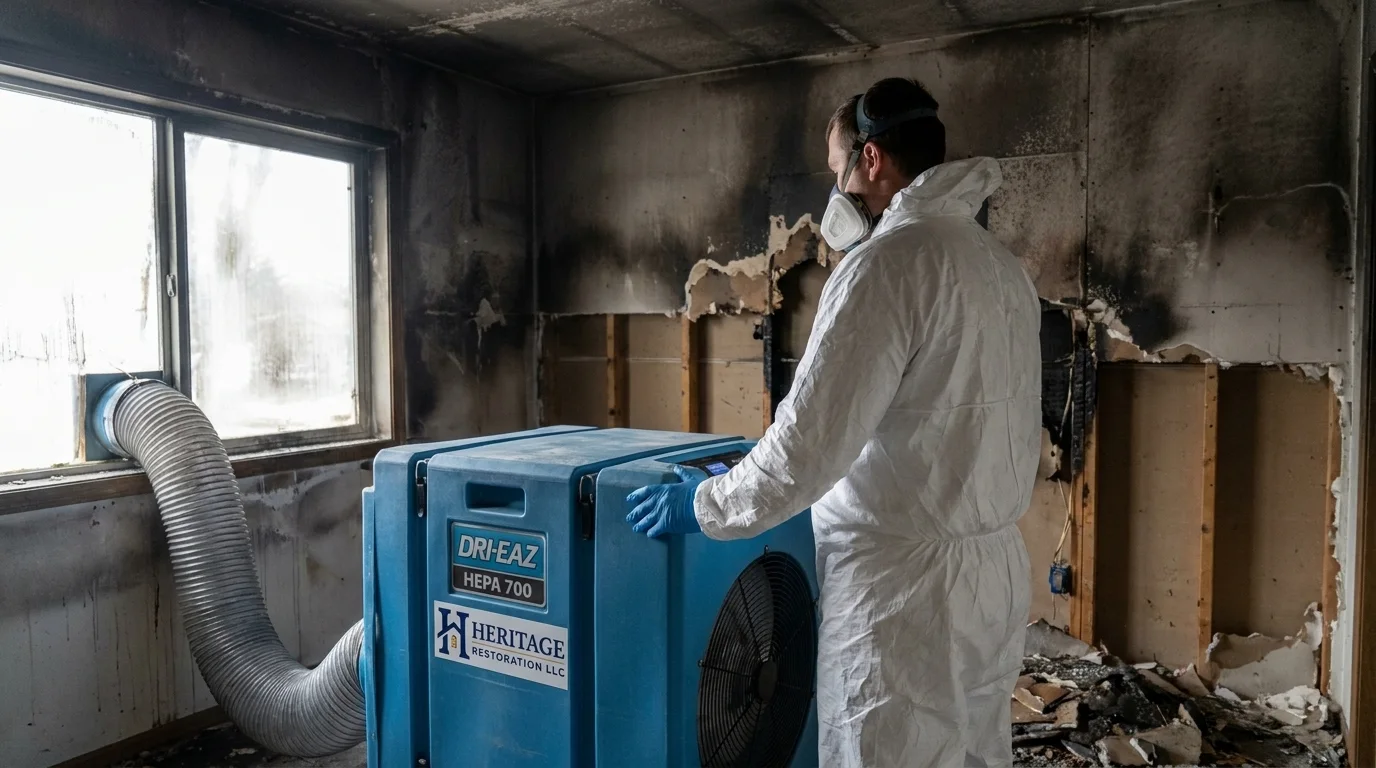
Emergency Fire Damage Restoration in Swanville
Emergency fire damage restoration in Swanville, MN. IICRC-certified, insurance billing accepted. Call (320) 733-8868.
Our IICRC-certified technicians are dispatched from our Little Falls, MN headquarters and are typically on-site in Swanville within 60 minutes of your call.
Fire damage emergency in Swanville? Call now for emergency service. Our crew responds fast to secure the property and start the recovery.
Swanville sits in Morrison County’s lake-dotted landscape, where long winters, older rural housing stock, and the kind of tight-knit small-town construction that hasn’t changed much in decades all shape how a house fire behaves and what it takes to recover from one. When smoke works its way into the gaps of a 1960s-era farmhouse or a wood-framed home built before modern vapor barriers were standard, the damage runs deeper than the char you can see. Heritage Restoration LLC holds IICRC FSRT (Fire and Smoke Restoration) certification and responds to fire damage calls in Swanville and the surrounding Morrison County area from our base in Little Falls.
Why Swanville Properties See Distinct Fire Damage Challenges
Much of the residential building stock in and around Swanville was constructed during an era when wood framing was heavier, insulation cavities were smaller, and interior finishes leaned toward plaster and wood paneling rather than today’s drywall. Those older materials hold smoke odor differently. Plaster, in particular, is porous enough to absorb soot particles and volatile organic compounds deep into its surface, meaning a fire that looks contained to one room can leave odor problems throughout the house if the structure isn’t assessed and treated systematically.
Morrison County’s cold winters add another layer of complexity. When a fire occurs in January or February and exterior temperatures are well below freezing, the suppression water from firefighting operations can freeze inside wall cavities before it ever gets a chance to drain. That trapped moisture, combined with smoke-saturated framing, creates conditions where secondary mold colonization can begin within days. Addressing both the fire and smoke damage and the moisture left behind is not optional in this climate; it’s part of the same job.
Wood-burning stoves and older heating systems are also more common in rural Morrison County than in metro areas, and chimney-related fires or heating appliance failures are a recurring cause of structural fire damage in this region. The resulting soot from incomplete combustion, sometimes called wet or oily soot, is among the most difficult residue types to clean because it smears rather than brushes away and bonds to surfaces aggressively.
Our Fire Damage Restoration Process in Swanville
Every fire loss is different, but the sequence of work follows a consistent logic. The first step on-site is a full structural and content assessment: what burned, what was smoke-affected, what was wet from suppression, and what is structurally sound enough to restore versus what needs to come out. We document all of this with photographs and written scope notes, which becomes the foundation of the insurance claim.
Demolition of unsalvageable materials comes next, followed by HEPA vacuuming of all soot-affected surfaces before any wet cleaning begins. Wet-cleaning soot before dry removal is one of the most common mistakes in fire cleanup, and it drives staining deeper into porous materials. After surface cleaning, we apply appropriate sealers to framing and subfloor where odor has penetrated the wood grain, then treat the air with thermal fogging or hydroxyl generation to address airborne odor molecules that surface cleaning alone cannot reach.
Structural drying runs concurrently with smoke remediation when suppression water is present. Our IICRC ASD (Applied Structural Drying) certification means we monitor moisture readings in walls, floors, and ceilings throughout the drying phase rather than estimating by feel or appearance.
Reaching Swanville from Little Falls
Our Little Falls headquarters puts us on U.S. Highway 10 with a straightforward route into Morrison County. Swanville is a manageable drive from our shop, and we serve the broader county including the rural addresses and township roads that can add travel time in winter conditions. We do not publish a response-time guarantee in minutes, but we prioritize fire calls and will give you a clear arrival estimate when you call (320) 733-8868.
Swanville Insurance Coordination
Fire damage claims in Minnesota typically involve a property adjuster visit before or shortly after remediation begins. We work alongside adjusters by providing itemized documentation, moisture logs, and scope-of-work reports in the format carriers expect. Being IICRC-certified matters here because adjusters and carriers recognize IICRC standards as the industry benchmark, which reduces friction when scope disputes arise. We bill carriers directly where assignment of benefits is permitted and walk you through the process if this is your first significant property claim.
Local Note
Older homes in rural Morrison County, including many in the Swanville area, were built with balloon-frame construction rather than the platform framing used after roughly the mid-20th century. In a balloon-frame structure, wall cavities run continuously from the foundation to the roof line without fire-blocking between floors. That means smoke and heat from a fire on the first floor can travel vertically through wall cavities and affect the second floor or attic even when the visible fire damage appears limited to one level. During our initial assessment, we probe these cavities specifically in older homes because the scope of smoke penetration is almost always larger than the burn pattern on the walls suggests.
If your home in Swanville has been affected by fire, call Heritage Restoration LLC at (320) 733-8868. We will assess the full extent of the damage, including what the walls are hiding, and walk you through a clear restoration plan before any work begins.
Fire Damage Restoration in Swanville: Service Coverage
Frequently Asked Questions
How fast can you arrive for fire damage restoration in Swanville?
How does Morrison County's winter climate affect fire damage restoration timelines in Swanville?
Are older homes in the Swanville area harder to restore after a fire than newer construction?
What causes the persistent smoke smell that lingers in Swanville homes after a fire is out?
How does Heritage Restoration document fire damage for an insurance claim in Swanville?
Does Heritage Restoration handle both the fire cleanup and the reconstruction in Swanville, or only one phase?
Fire Damage Restoration response in Swanville
Most Swanville calls see a technician on-site within 60 minutes from our Little Falls headquarters.