
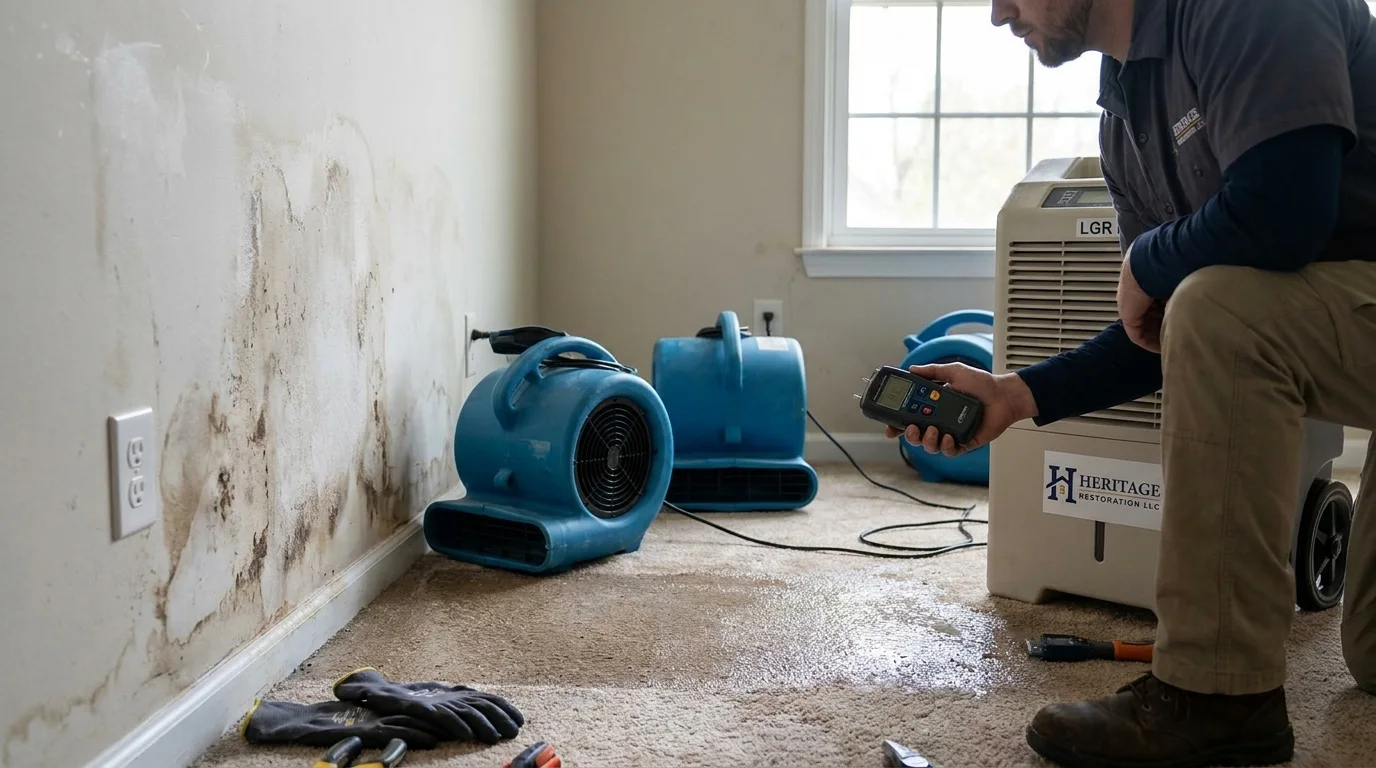
Emergency Water Damage Restoration in Swanville
Emergency water damage restoration in Swanville, MN. IICRC-certified, insurance billing accepted. Call (320) 733-8868.
Our IICRC-certified technicians are dispatched from our Little Falls, MN headquarters and are typically on-site in Swanville within 60 minutes of your call.
Water damage emergency in Swanville? Call now for emergency service. Our crew responds fast to stop the water and start drying your property.
Swanville sits in Morrison County, where the transition between central Minnesota’s lake country and its agricultural flatlands means water has plenty of places to go, and sometimes that place is inside your home. Spring snowmelt in this part of the state can be abrupt, and when frozen ground can’t absorb runoff fast enough, water finds its way through foundation walls, window wells, and basement floor drains before most homeowners realize what’s happening. Heritage Restoration LLC responds to water damage calls across Swanville and the surrounding Morrison County area, handling everything from burst pipes to storm-driven flooding with IICRC-certified water damage restoration.
Why Swanville Properties See Water Damage Issues
Morrison County’s freeze-thaw cycle is one of the most reliable sources of residential water damage in central Minnesota. Temperatures that swing hard below zero in January and then climb above freezing in late February create the conditions for ice damming on rooflines, pipe failures behind exterior walls, and frost heave that stresses foundation slabs. Homes built in the mid-twentieth century, a common vintage throughout rural Morrison County, often have galvanized steel supply lines and cast-iron drain stacks that are well past their designed service life. When those pipes fail, water doesn’t just pool on the floor; it wicks into wood subfloor, insulation batts, and wall cavities before the leak is even noticed.
Soil composition in this part of Minnesota also matters. The heavier clay-loam soils common in low-lying areas around Swanville drain slowly, which means saturated ground during a wet spring pushes hydrostatic pressure against basement walls and floor slabs for days after the rain stops. A sump pump that loses power or cycles out during a storm event can leave several inches of standing water in a finished basement in a matter of hours.
Our Water Damage Restoration Process in Swanville
The first priority on any water loss is stopping active intrusion and getting standing water out. Heritage Restoration uses truck-mounted and portable extraction equipment to pull water from carpet, hardwood, and concrete before it migrates further into structural materials. Once bulk water is removed, the work shifts to moisture mapping, using thermal imaging cameras and calibrated moisture meters to find water that has already traveled behind walls, under flooring, or into ceiling assemblies.
Structural drying in central Minnesota homes requires attention to ambient conditions that change with the season. In winter, indoor relative humidity is already low, which can accelerate surface drying while masking deeper moisture in framing. In spring and summer, high outdoor humidity means simply opening windows makes drying slower, not faster. Heritage Restoration’s IICRC ASD-certified technicians set drying systems based on psychrometric calculations, not guesswork, and monitor readings at each visit to confirm the structure is drying on a predictable curve. Affected materials that cannot be dried in place, saturated insulation, buckled flooring, compromised drywall, are removed and documented before reconstruction begins.
Reaching Swanville from Little Falls
Heritage Restoration’s base in Little Falls puts Swanville within a reasonable drive along U.S. Highway 10 and the county road network through Morrison County. When you call (320) 733-8868, the team can confirm scheduling and give you an honest arrival window based on current conditions and crew availability. In a water loss situation, the time between your call and the start of extraction matters, water that sits in a wood subfloor for more than a day begins to swell and delaminate, and the IICRC S500 standard recognizes that Category 1 losses can degrade to Category 2 within 24 to 48 hours if left unaddressed.
Swanville Insurance Coordination
Most homeowner policies in Minnesota cover sudden and accidental water discharge, a burst pipe, a washing machine supply line failure, or an ice dam breach, but exclude gradual leaks and ground flooding without a separate rider. Heritage Restoration documents losses thoroughly: moisture readings, thermal images, material inventories, and scope notes formatted to match what adjusters need to process a claim. That documentation also protects you if there is a dispute about what was wet and what was pre-existing.
If you are unsure whether your policy covers the specific cause of your loss, the documentation Heritage Restoration provides gives your adjuster the clearest possible picture of what happened and when.
Local Note
One pattern that comes up in Morrison County homes built before 1970 is the use of vermiculite or fiberglass batt insulation packed directly against basement rim joists. When that rim joist area gets wet during a spring flood event, the insulation holds moisture against the wood for weeks after the rest of the basement has dried out. Surface readings at the floor level can look normal while the rim joist framing is still well above safe moisture content. Technicians working in Swanville-area homes need to check that zone specifically, because missing it is one of the more common reasons mold colonizes a basement that was thought to be fully dried.
If you are dealing with water in your home or property in Swanville, call Heritage Restoration LLC at (320) 733-8868. The sooner extraction and drying equipment is running, the narrower the scope of damage, and the lower the final restoration cost.
Water Damage Restoration in Swanville: Service Coverage
Frequently Asked Questions
How fast can you arrive for water damage restoration in Swanville?
How quickly can Heritage Restoration reach Swanville from Little Falls after I call?
Does the freeze-thaw cycle in Morrison County affect how long water damage drying takes?
Are older homes in the Swanville area more at risk for hidden water damage after a pipe failure?
Will my homeowner's insurance cover water damage from spring snowmelt flooding in Swanville?
What happens if water got into the rim joist area of my Swanville home's basement?
Water Damage Restoration response in Swanville
Most Swanville calls see a technician on-site within 60 minutes from our Little Falls headquarters.