
Emergency Storm Damage Restoration in Long Prairie
Emergency storm damage restoration in Long Prairie, MN. IICRC-certified, insurance billing accepted. Call (320) 733-8868.
Our IICRC-certified technicians are dispatched from our Little Falls, MN headquarters and are typically on-site in Long Prairie within 60 minutes of your call.
Storm damage emergency in Long Prairie? Call now for emergency service. Our crew responds fast to secure the property and stop further damage.
Long Prairie sits in the heart of Todd County, where the transition between Minnesota’s northern lake country and the central agricultural plains creates a meteorological mixing zone that produces some of the state’s most unpredictable severe weather. Thunderstorms that build over the prairie to the south can intensify rapidly as they push north toward the lakes, arriving with little warning and leaving behind a combination of wind damage, hail impact, and water intrusion that requires a different response than a straightforward rain event.
Why Long Prairie Properties See Storm Damage Differently
Todd County’s housing stock tells a story in its rooflines and siding. A significant portion of Long Prairie’s residential properties date from the mid-twentieth century or earlier, built with construction methods that predate modern wind-load standards. Older wood-frame homes with original cedar or asphalt shingles can lose significant coverage in a single high-wind event, and once the roof deck is exposed, water moves fast. In a Minnesota summer storm, you can have an inch of rain through an open roof gap within the hour.
The region also sits within a documented tornado corridor. Todd County has recorded tornado touchdowns in multiple decades, and the flat-to-rolling terrain between Long Prairie and the surrounding townships offers little natural windbreak for properties on the town’s edges. Hail is a separate concern: storms that track across the open farmland west of town often carry large-diameter hail that damages not just shingles but gutters, siding, window frames, and HVAC equipment simultaneously.
Soil saturation compounds the problem. The clay-heavy soils common across much of Todd County drain slowly. After a heavy storm event, standing water around foundations lingers longer than it would in sandier terrain, increasing the window for basement seepage and crawl space intrusion.
Our Storm Damage Restoration Process in Long Prairie
When Heritage Restoration LLC responds to a storm-damaged property in Long Prairie, the first priority is a thorough exterior and interior assessment before any work begins. Wind events rarely damage just one system. A crew that fixes the visible roof tear without checking whether water has already reached the wall cavity or subfloor is setting the homeowner up for a mold problem weeks later.
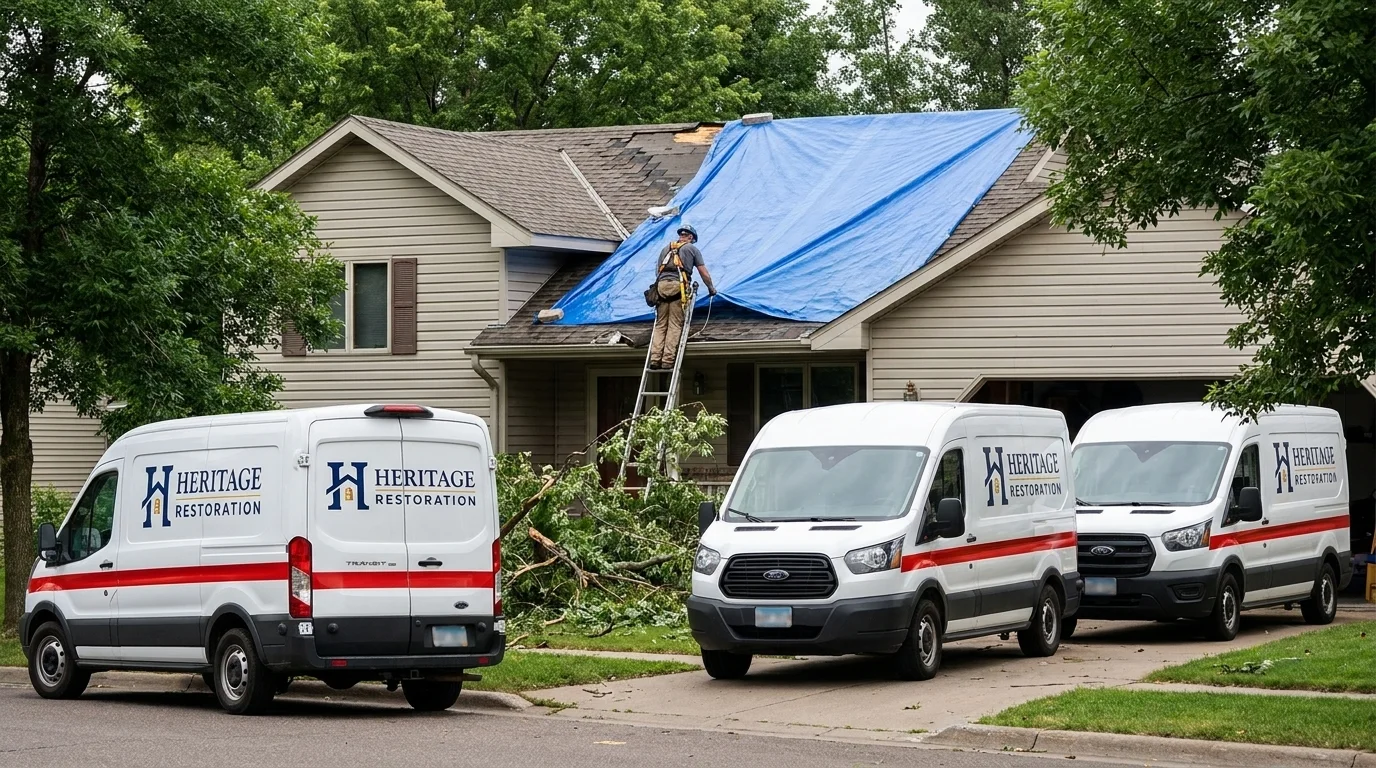
The process moves in a deliberate sequence. Emergency tarping and board-up stabilizes the structure and stops active water entry. Interior moisture mapping follows, using thermal imaging and calibrated moisture meters to trace where water has traveled beyond the obvious wet spots. Structural drying, performed to IICRC S500 and S520 standards, uses industrial air movers and desiccant or refrigerant dehumidifiers sized to the actual affected volume, not a one-size estimate. Debris removal, damaged material extraction, and reconstruction planning happen in parallel with documentation for the insurance claim.
Heritage holds IICRC certifications in Water Restoration, Structural Drying, Fire and Smoke Restoration, and Mold Remediation, along with EPA Lead-Safe Certification. That last credential matters in Long Prairie’s older housing stock: pre-1978 homes disturbed during storm repair work require lead-safe practices, and the team is equipped to handle that without stopping the job for a separate contractor.
Reaching Long Prairie from Little Falls
Heritage Restoration LLC is based in Little Falls, roughly 25 miles southeast of Long Prairie via US-10. That route is a direct, well-maintained corridor that keeps response times practical for Todd County properties. Crews can stage equipment and be en route quickly after a storm event clears enough for safe travel on the highway.
For properties on the north or west sides of Long Prairie, the approach along MN-27 or County Road 11 is equally accessible. The relatively compact geography of Long Prairie itself means that once a crew is in town, travel between neighborhoods is a matter of minutes, not a logistical challenge.
Long Prairie Insurance Coordination
Storm damage claims in Minnesota are subject to the state’s Department of Commerce regulations governing contractor solicitation and assignment of benefits, which affect how restoration companies can interact with policyholders during the claims process. Heritage works directly with homeowners and their adjusters, providing detailed photo documentation, moisture logs, and scope-of-work reports in the format most carriers require.
For Todd County properties, it is worth knowing that some rural policies written through farm bureau or agricultural insurers carry different coverage structures for outbuildings and detached structures than standard homeowner policies. If your property includes a garage, shop, or barn that took storm damage alongside the main residence, flag that to your adjuster early and confirm coverage scope before restoration work begins.
Local Note
Long Prairie’s older residential blocks include homes built with true-dimension lumber framing and original plaster-and-lath interior walls. When storm-driven water gets behind plaster, it behaves differently than it does in modern drywall construction. Plaster is dense and slow to release moisture, which means a wall can read nearly dry at the surface on a moisture meter while the lath and framing behind it remain saturated. Crews working in Long Prairie’s older neighborhoods need to account for extended drying times and should not rely on surface readings alone to call a structure dry. Heritage’s IICRC-certified structural drying protocol includes cavity monitoring and extended equipment runtime when plaster construction is present.
If your home has taken storm damage and you are not sure what the next step is, call Heritage Restoration LLC at (320) 733-8868. The team serves Long Prairie and the surrounding Todd County area and can walk you through what the assessment process looks like before any commitment is made.
Storm Damage Restoration in Long Prairie: Service Coverage
Frequently Asked Questions
How fast can you arrive for storm damage restoration in Long Prairie?
How quickly can Heritage Restoration reach Long Prairie after a storm event?
Does Long Prairie's older housing stock affect how storm damage restoration is handled?
Is tornado or severe wind damage common enough in the Long Prairie area to warrant a specific inspection checklist?
What should I know about filing a storm damage insurance claim for a Todd County property?
How do you determine whether storm-driven water has reached areas that are not visibly wet in a Long Prairie home?
Storm Damage Restoration response in Long Prairie
Most Long Prairie calls see a technician on-site within 60 minutes from our Little Falls headquarters.
Nearby & Related
- Emergency Storm Damage Restoration in Little Falls
- Restoration Services in Long Prairie
- Emergency Fire Damage Restoration in Long Prairie
- Roofing Installation and Replacement in Long Prairie
- Emergency Storm Damage Restoration in Albany
- Emergency Storm Damage Restoration in Avon
- Contact Heritage Restoration LLC