
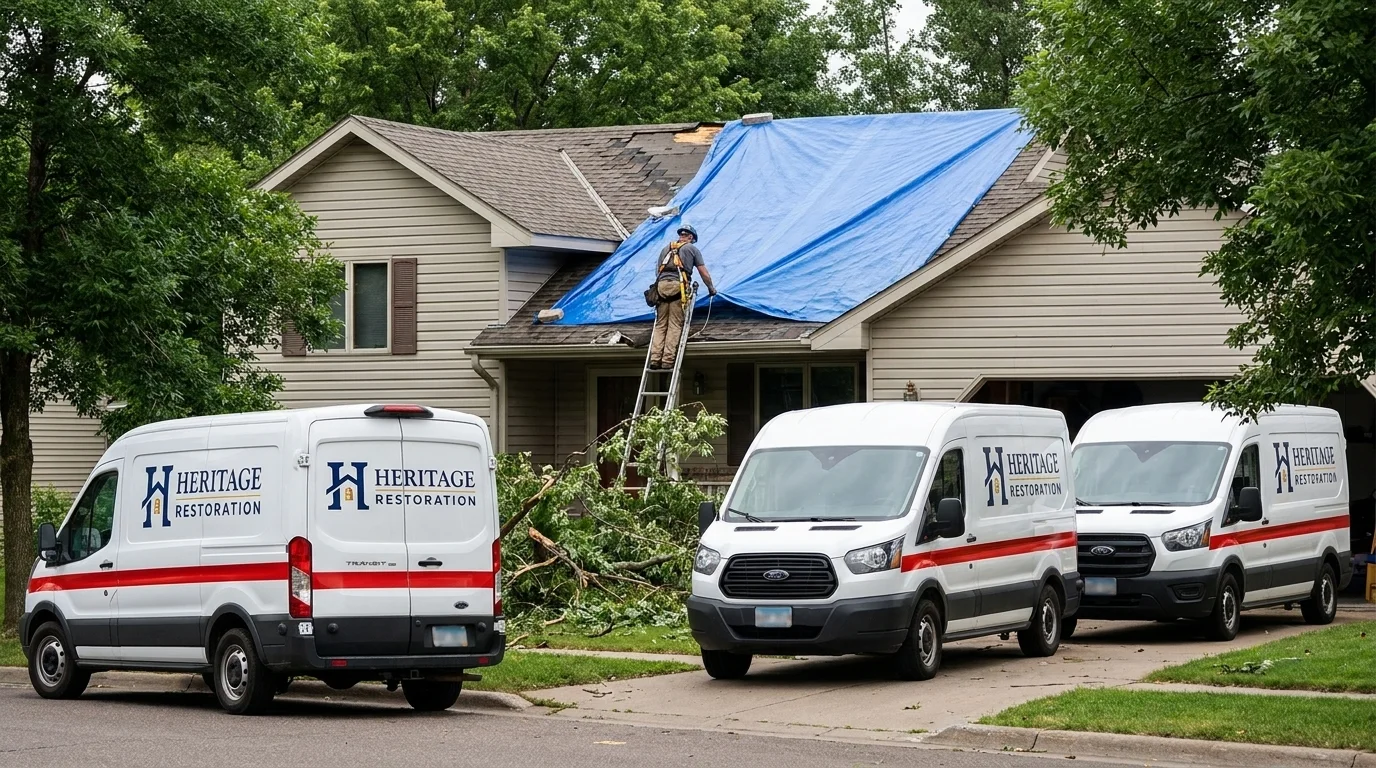
Emergency Storm Damage Restoration in Albany
Emergency storm damage restoration in Albany, MN. IICRC-certified, insurance billing accepted. Call (320) 733-8868.
Our IICRC-certified technicians are dispatched from our Little Falls, MN headquarters and are typically on-site in Albany within 60 minutes of your call.
Storm damage emergency in Albany? Call now for emergency service. Our crew responds fast to secure the property and stop further damage.
Central Minnesota’s storm season hits Stearns County hard, and Albany sits squarely in the path of the fast-moving systems that funnel down from the north and northwest each spring and summer. When a severe thunderstorm drops a white oak across a roofline or a straight-line wind event peels back soffit and drives rain into wall cavities, the clock starts immediately. Moisture that reaches wood framing or insulation in an older Albany home can begin supporting mold growth within 24 to 48 hours, which means the gap between the storm passing and your first call matters.
Why Albany Properties See Storm Damage Differently
Albany and the surrounding Stearns County townships sit in a transition zone where cold Canadian air masses collide with warm Gulf moisture through late spring and into August. That combination produces not just heavy rain but hail, damaging wind, and the occasional tornado warning that sends residents to basements along County Road 10 and the surrounding rural routes. The housing stock here reflects decades of growth around Albany’s agricultural and small-town economy: a mix of post-war single-story homes, newer construction on the town’s edges, and older farmhouses that were built before modern weather-resistant sheathing was standard. Those older structures often have board sheathing beneath their siding rather than plywood or OSB, and board sheathing has gaps that let wind-driven rain migrate deep into wall assemblies in ways that modern homes resist. A storm that leaves a newer build with surface damage can leave a 1960s Albany home with saturated insulation and wet framing that won’t show on the surface for days.
Hail is a separate concern. A hail event that damages asphalt shingles may look cosmetic from the ground, but compromised shingles allow water infiltration at every subsequent rain. By the time a homeowner notices ceiling staining, the attic insulation and roof deck may already be holding significant moisture.
Our Storm Damage Restoration Process in Albany
The first step on any storm-damaged property is a thorough assessment before any materials are moved or dried. That means probing wall cavities with moisture meters, checking attic spaces for hidden water intrusion, and documenting everything photographically for your insurance carrier. Visible damage tells only part of the story; the moisture map tells the rest.
Once the scope is clear, the process moves in a defined sequence. Tarping or board-up work addresses any remaining openings to stop additional water entry. Saturated insulation is removed because it holds moisture against framing and cannot be dried in place effectively. Industrial air movers and desiccant or refrigerant dehumidifiers are positioned based on the moisture readings, not by a standard formula, because every structure dries differently depending on its construction and the volume of water involved. Drying progress is monitored on a scheduled basis and documented until affected materials reach acceptable moisture levels. Only then does reconstruction begin.
Heritage Restoration LLC holds IICRC certifications in Water Damage Restoration, Structural Drying, and Applied Microbial Remediation, which means the drying phase follows the IICRC S500 standard rather than a best-guess timeline.
Reaching Albany from Little Falls
Heritage Restoration LLC is based in Little Falls, roughly 35 miles east of Albany via U.S. Highway 10 and Minnesota State Highway 238. That route is straightforward in fair conditions and manageable even after most storm events, though significant ice or downed trees on 238 can add time. When you call (320) 733-8868, the team will give you an honest estimate of arrival based on current road conditions rather than a number that sounds good on paper.
For properties on Albany’s west side or along the rural township roads that feed into town, it helps to mention your road and any access issues when you call, particularly if a tree or debris is blocking a shared driveway or a gravel approach.
Albany Insurance Coordination
Storm damage claims in Minnesota are typically covered under the dwelling portion of a standard homeowner’s policy, but the documentation requirements vary by carrier. Some adjusters will accept a contractor’s moisture log and photo set as the primary evidence; others require a separate adjuster inspection before any drying work begins. Heritage Restoration LLC documents losses thoroughly from the first visit so that the record supports your claim regardless of which carrier is involved. We can communicate directly with adjusters and provide the scope of work in a format most carriers recognize, which reduces the back-and-forth that delays settlements.
If your property is subject to an HOA, check your association’s rules before exterior repairs begin. Some Albany-area developments have specific requirements around approved roofing materials or siding colors that affect what can be installed during reconstruction.
Local Note
One pattern worth knowing in Albany and the broader Stearns County area: many homes built in the 1970s and 1980s used fiberglass batt insulation in exterior walls without a continuous vapor barrier, or with a barrier that was installed inconsistently. When wind-driven rain enters through storm-damaged siding or soffit, that insulation absorbs and holds moisture against the interior wall surface. It reads dry at the drywall face because the paper facing blocks the meter probe, but the batt behind it can be fully saturated. If your storm damage involved any siding breach, even a small one, it is worth having wall cavities checked with a probe-style meter before assuming the interior is unaffected.
If your Albany property has taken storm damage, call Heritage Restoration LLC at (320) 733-8868. The team will assess the full scope of the loss, document it for your carrier, and work through the drying and reconstruction process in a sequence that protects the structure rather than rushing to close out the job.
Storm Damage Restoration in Albany: Service Coverage
Frequently Asked Questions
How fast can you arrive for storm damage restoration in Albany?
How long does it typically take to reach an Albany property from your Little Falls location?
Albany gets significant hail most summers. Does hail damage always require interior restoration work?
Are older homes in the Albany area more vulnerable to storm damage than newer construction?
What does the drying process actually look like inside an Albany home after storm water intrusion?
How does Heritage Restoration LLC handle insurance documentation for Albany storm claims?
Storm Damage Restoration response in Albany
Most Albany calls see a technician on-site within 60 minutes from our Little Falls headquarters.