
TL;DR: Water damage restoration in Minnesota typically costs $1,500 to $15,000 or more, depending on how much water entered, what type of water it was, and what building materials got saturated. A single-room clean-water leak runs $1,500 to $4,000. A finished basement with sewage backup can exceed $20,000. Every loss is different, and accurate pricing requires an on-site assessment, but these ranges give you a realistic starting point before the adjuster arrives.
You came home to standing water, or you found a slow leak that’s been soaking your subfloor for who knows how long. Now you’re trying to figure out what this is going to cost before you call anyone. That’s a smart move. Water damage restoration pricing is not one-size-fits-all, the same 200-square-foot bathroom can cost $1,800 or $8,000 depending on what the water touched and where it came from. Here’s how the numbers actually break down.
How Much Does Water Damage Restoration Cost by Job Size?
National cost data consistently shows that job size, measured in affected square footage and number of rooms, is the single biggest driver of the final invoice. Larger losses require more equipment, more labor days, and more material removal.
| Job Scenario | Typical National Range |
|---|---|
| Single room, clean water (Cat 1) | $1,500 - $4,000 |
| Single room, gray water (Cat 2) | $2,500 - $6,500 |
| Single room, black water (Cat 3) | $4,000 - $10,000 |
| Finished basement, clean water | $3,500 - $9,000 |
| Finished basement, gray/black water | $8,000 - $20,000+ |
| Whole floor (1,000+ sq ft), clean water | $6,000 - $15,000 |
| Whole floor (1,000+ sq ft), gray/black water | $12,000 - $25,000+ |
These are typical industry ranges based on national cost data. Local pricing in Little Falls and the surrounding Morrison County area depends on the specific scope of your loss, an on-site assessment is the only way to get an accurate number.
How Much Does Water Damage Restoration Cost Per Square Foot?
Cost-per-square-foot figures help you cross-check an estimate, but they vary significantly by water category and materials affected.
| Water Category | Typical Cost Per Square Foot |
|---|---|
| Category 1 (clean water) | $3.75 - $7.00/sq ft |
| Category 2 (gray water) | $6.50 - $10.00/sq ft |
| Category 3 (black water) | $9.00 - $14.00/sq ft |
These figures cover extraction, drying, and basic antimicrobial treatment. They do not include flooring replacement, drywall reconstruction, or contents pack-out, those are separate line items. For a detailed breakdown of what the restoration process involves, see How Long Does Water Damage Restoration Actually Take?.
What Is Water Category, and Why Does It Change the Price So Much?
Water category is the single most important pricing variable in any restoration estimate. The IICRC S500 Standard, the industry’s governing document for water damage restoration, defines three categories based on contamination level.
Category 1 (clean water) comes from a supply line, a broken appliance hose, or a rain intrusion through a window. It poses no immediate health risk. Drying times are shorter, and crews can often save more materials. This is the least expensive category.
Category 2 (gray water) comes from dishwashers, washing machines, toilet overflows (urine only), or sump pump failures. It contains biological or chemical contaminants. More materials typically need to be removed rather than dried in place, and antimicrobial treatment is required throughout.
Category 3 (black water) is grossly contaminated water: sewage backups, floodwater from rivers or storm drains, or any water that has sat long enough to grow bacteria. All porous materials that Category 3 water touched, drywall, insulation, carpet, pad, are removed and disposed of. No exceptions. This is the most expensive category because the scope of removal is much larger.
One important note: water can degrade categories over time. Clean water that sits for 48 to 72 hours in a warm space can become Category 2 or Category 3 as bacteria grow. This is one reason fast response matters, not just for the structure, but for your final invoice. For more on the timeline, see What To Do in the First 24 Hours After Water Damage.
What Else Moves the Number Up or Down?
Beyond water category and square footage, several other factors push restoration costs higher or lower.
Drying time. The IICRC S500 standard targets structural drying to pre-loss moisture content, typically 3 to 5 days for a straightforward loss, up to 10 or more days for a saturated concrete slab or dense framing. Each additional drying day means more equipment rental time and more monitoring visits. Crews use large-capacity LGR (low-grain refrigerant) dehumidifiers and high-velocity air movers, a typical residential job runs 4 to 12 air movers and 1 to 3 dehumidifiers, all metered daily.
Materials affected. Hardwood floors, tile over concrete, and plaster walls behave very differently from carpet and standard drywall. Hardwood can sometimes be dried in place with specialty drying mats; other times it cups and buckles beyond saving. Plaster (common in older Morrison County homes) is dense and slow to dry. Each material type changes the equipment strategy and the labor hours.
Structural drying class. The IICRC also classifies losses by how much water absorbed into structural materials. Class 1 (minimal absorption) dries quickly and costs less. Class 4 (specialty drying situations, concrete, hardwood, plaster) requires longer drying cycles and specialty equipment, which adds cost.
Contents pack-out. If furniture, clothing, or personal property needs to be moved off-site for drying or cleaning, that’s a separate line item. Pack-out services typically add $500 to $3,000+ depending on volume.
Reconstruction scope. Restoration (drying and stabilizing) and reconstruction (rebuilding what was removed) are often separate contracts. If drywall, flooring, or cabinetry needs to be replaced after drying, those costs are in addition to the mitigation invoice. General contracting services can handle reconstruction once the structure is dry and cleared.
Does Homeowners Insurance Cover Water Damage Restoration?
Most standard homeowners policies cover sudden, accidental water damage, a burst pipe, a failed appliance supply line, or an ice dam that forces water through the roof. They typically do not cover gradual leaks, flooding from outside the home (that requires separate flood insurance through the National Flood Insurance Program), or damage caused by deferred maintenance.
The Insurance Information Institute notes that water damage and freezing is one of the most common homeowners insurance claims, and one of the most frequently disputed. Documentation is everything. Before any work begins, photograph every affected surface from multiple angles. Keep the failed component (the burst pipe fitting, the cracked supply hose), adjusters sometimes ask to inspect it. Get a written scope of work from your restoration contractor before signing anything.
For a deeper look at what policies actually cover, see Does Homeowners Insurance Cover Water Damage? A Plain-English Guide.
One practical note: your deductible applies before insurance pays anything. If your deductible is $2,500 and the mitigation invoice is $3,200, you’re paying most of it out of pocket. Knowing your deductible before you call your insurer helps you make a faster decision.
What Does Water Damage Restoration Actually Include?
A full water damage restoration job typically covers these phases:
- Emergency water extraction. Truck-mounted or portable extractors remove standing water first. This happens within the first few hours.
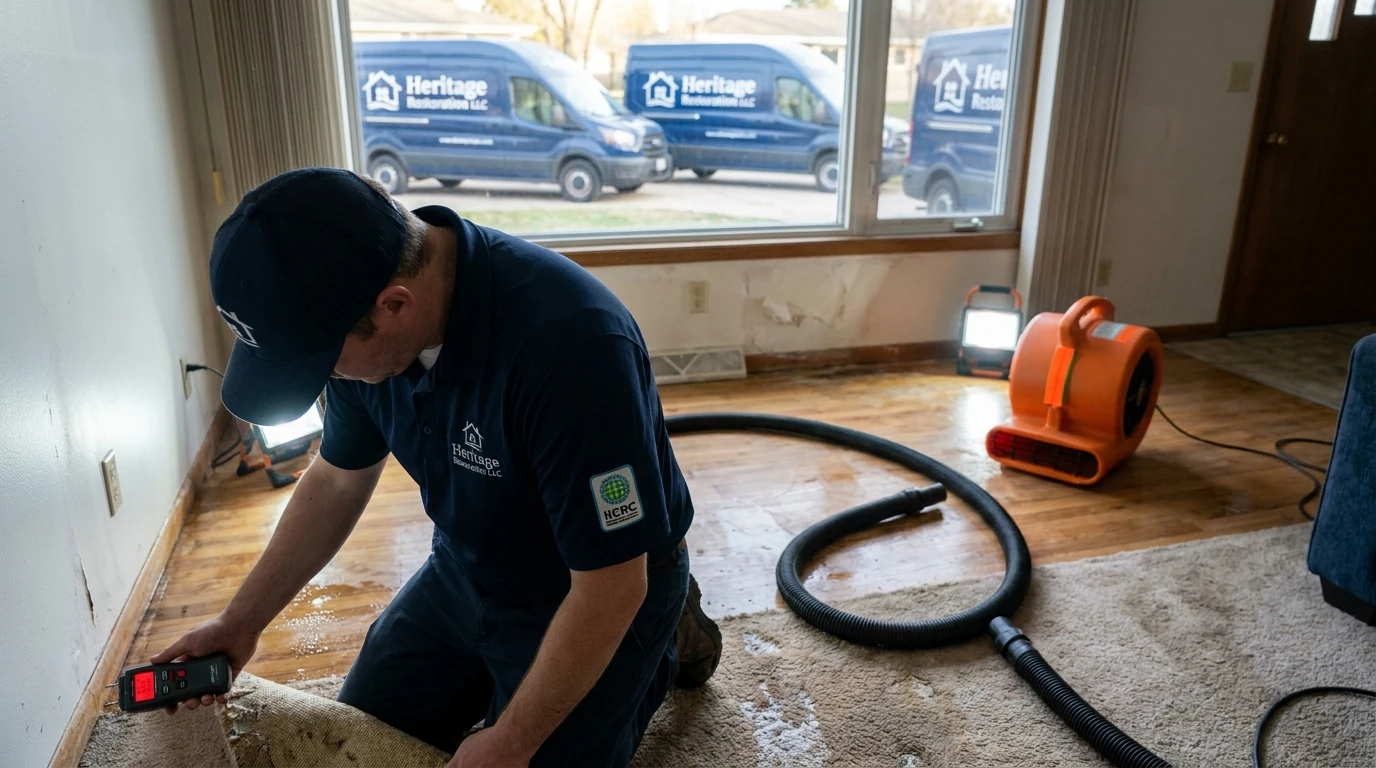
- Moisture mapping. Technicians use thermal imaging cameras and pin/pinless moisture meters to find where water traveled inside walls, under floors, and above ceilings. This defines the drying zone.
- Controlled demolition (if needed). Wet drywall below the flood cut line is removed. Saturated insulation is bagged and disposed of. Wet carpet and pad are pulled. Category 3 losses require more aggressive removal.
- Drying system deployment. Air movers and LGR dehumidifiers run continuously, typically 24 hours a day, until moisture readings reach target levels.
- Daily monitoring. A technician visits each day to record moisture readings and adjust equipment placement. Readings are logged, this documentation supports your insurance claim.
- Antimicrobial treatment. Applied to structural cavities and surfaces after drying, especially for Category 2 and 3 losses.
- Final clearance readings. When moisture levels return to pre-loss standards, equipment is removed and a final report is generated.
What’s not included: reconstruction of removed materials. That phase begins after the structure passes final drying clearance.
What Should You Do Next?
If you have active water intrusion, stop the source first, shut off the supply valve or call a plumber if the pipe is still flowing. Then call a certified restoration contractor to start extraction. Every hour of delay allows water to migrate further into walls and subfloor, which expands the drying zone and the final cost.
For water damage in Little Falls and the surrounding area, Heritage Restoration LLC is IICRC-certified in Water Damage Restoration (WRT) and Applied Structural Drying (ASD), licensed (BC807677), and locally based. They provide a written scope before work begins, no surprises on the invoice. You can reach them at (320) 733-8868 or request an assessment online.
For more on what to expect from the process, the water damage restoration service page and water cleanup service page outline how jobs are scoped and what the documentation looks like for insurance purposes.
About Heritage Restoration LLC
Heritage Restoration LLC is an IICRC-certified restoration company based in Little Falls, MN, serving Morrison County and the surrounding region since 2023 (license BC807677). The company holds IICRC certifications in Water Damage Restoration (WRT), Applied Structural Drying (ASD), Fire and Smoke Restoration (FSRT), and Mold Remediation (AMRT), and is EPA Lead-Safe Certified. Services include water damage restoration, water cleanup, storm damage restoration, and general contracting across Little Falls, St. Cloud, Brainerd, and surrounding communities.