
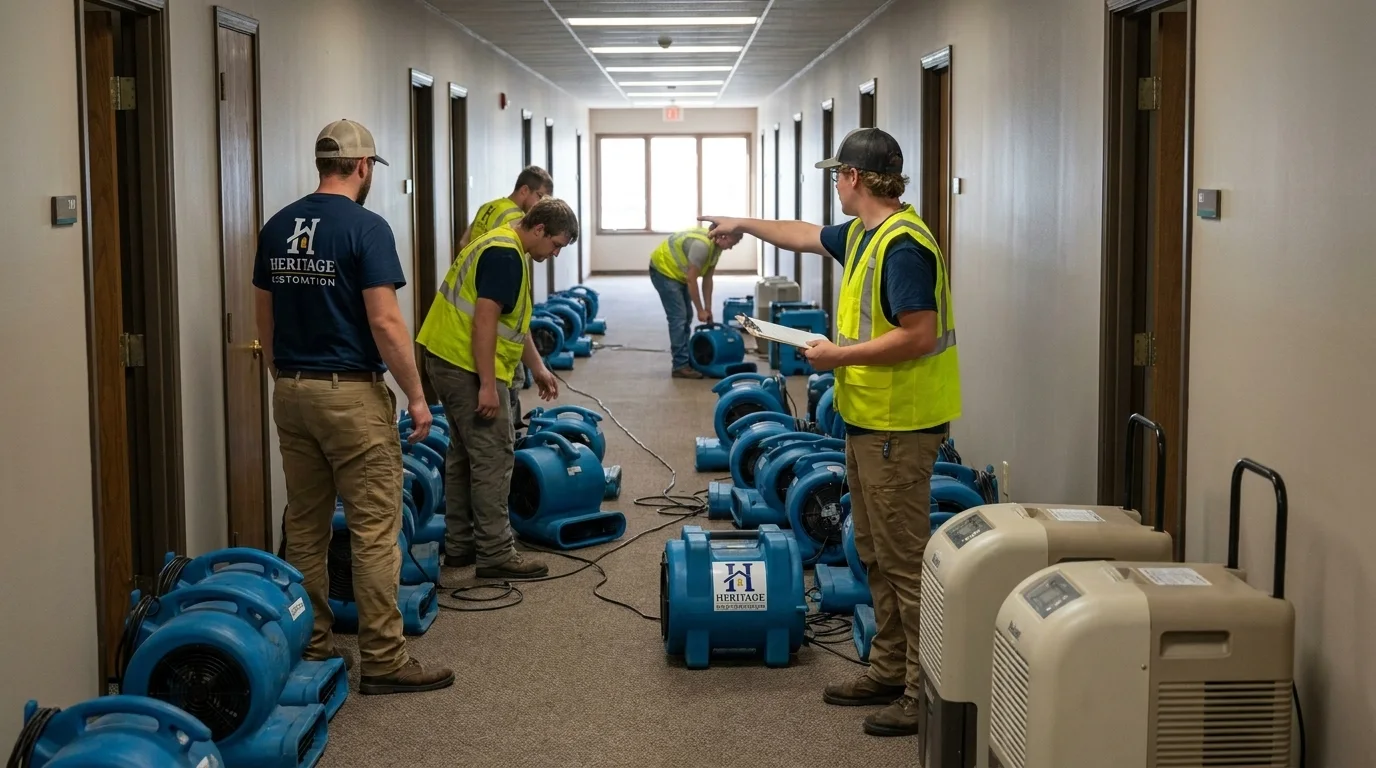
Large Loss and Catastrophic Response in Little Falls
Large loss and catastrophic response in Little Falls and surrounding areas. IICRC-certified, insurance billing accepted. Call (320) 733-8868.
When a commercial building takes on multiple feet of water, a fire works through several floors of a mixed-use structure, or a storm peels back a roof system across an entire complex, the loss stops being something one crew and a few air movers can solve. Large loss and catastrophic response is the coordinated, multi-crew mobilization required when square footage, dollar value, or business interruption exposure crosses a threshold that standard residential response wasn’t built for. It’s a different scale of logistics, documentation, and subcontractor coordination, not just a bigger version of a normal job.
What Large Loss and Catastrophic Response actually involves
A catastrophic loss is typically defined by scope rather than cause: a property with six figures or more in anticipated reconstruction costs, multiple affected buildings or units, or a single event (flooding, a major fire, a roof collapse, a widespread freeze event) that damages more than one structure at once. For these jobs, Heritage Restoration LLC scales crew size and equipment to match the loss rather than running it through a standard single-crew workflow. That means multiple extraction and drying teams working simultaneous zones, generators and desiccant dehumidification for buildings without working power, and a project manager dedicated to tracking moisture logs, drying equipment counts, and daily progress across every affected area. Timelines run from days for a contained multi-unit water loss to months for a structure requiring full reconstruction after fire or structural storm damage. Our team holds IICRC credentials across water (WRT), structural drying (ASD), fire and smoke (FSRT), and mold (AMRT), which matters on catastrophic jobs because the loss rarely stays confined to one category of damage.
Our process
- Scope verification and triage. Before equipment moves in, we walk the full affected footprint to confirm the actual scope, building out a priority map so life-safety hazards and the areas at highest risk for secondary damage (electrical rooms, below-grade mechanicals, unoccupied units) get addressed first.
- Mobilization and resource allocation. Crew size, generator capacity, and drying equipment are scaled to the structure, not assigned from a standard job template. On a multi-building loss this often means staggered mobilization so power and water access are confirmed zone by zone before full crews deploy.
- Multi-zone mitigation. Extraction, demolition of unsalvageable materials, and structural drying run in parallel across separate zones, each tracked independently with its own moisture logs and drying targets so no area gets overlooked once attention shifts to the next phase.
- Daily documentation and adjuster coordination. On large loss files, insurance carriers and third-party adjusters expect daily or near-daily updates: moisture readings, photos, equipment counts, and labor logs. We build this documentation into the workflow from day one rather than reconstructing it after the fact.
- Transition to reconstruction. Once drying and remediation are verified complete, we hand off a documented scope of work for rebuild, coordinating trades so reconstruction starts without a gap in the property’s documentation trail.
What separates a good large loss response from a bad one
The most common failure on catastrophic jobs isn’t poor drying technique, it’s poor documentation and sequencing. Crews that treat a 40,000-square-foot loss like four separate 10,000-square-foot jobs end up with inconsistent moisture logs, gaps in daily photos, and equipment counts that don’t reconcile with the invoice, all of which slow down adjuster approval and payment. Insurance carriers reviewing large loss claims look specifically for a single, continuous set of records: one moisture mapping system, one equipment log, one point of contact managing the file. Another common mistake is under-resourcing the drying phase to control cost, which looks efficient early but leads to secondary mold growth or warped materials that generate a second claim weeks later. A properly run catastrophic job also coordinates subcontractors (electrical, plumbing, structural engineers) early, rather than waiting until mitigation is complete to find out the rebuild needs permits or engineering sign-off that could have been initiated in week one.
What does Large Loss and Catastrophic Response cost?
Catastrophic losses vary enormously depending on building size, number of units or floors affected, and whether the damage involves water, fire, structural collapse, or a combination. Typical industry figures below are for general reference only; every loss is different, and Heritage Restoration LLC provides a written scope of work before mobilizing crews so the property owner and carrier are working from the same numbers.
| Scenario | Typical range |
|---|---|
| Multi-unit water loss, 2-4 units | $25,000 - $75,000 |
| Commercial building, single-floor flooding | $50,000 - $150,000 |
| Multi-floor fire with structural damage | $150,000 - $500,000+ |
| Large apartment or mixed-use complex, storm damage | $200,000 - $750,000 |
| Full structure loss requiring reconstruction | $500,000 - $2,000,000+ |
Most commercial property policies cover catastrophic water, fire, and storm damage, including business interruption in many cases, but coverage details (demolition, code upgrades, loss of use) vary significantly by policy, which is why early adjuster coordination matters on a loss this size.
Seasonal & regional considerations
Morrison County’s winters bring a specific catastrophic risk profile: frozen and burst fire suppression lines in unheated commercial space, roof collapse from heavy snow load on flat or low-slope commercial roofs, and freeze-thaw cycles that can turn a contained pipe break into a multi-floor water loss overnight in an unoccupied building. Spring snowmelt combined with Mississippi River-adjacent drainage adds flood exposure for lower-lying commercial properties. Any of these can escalate a routine service call into a catastrophic-scale mobilization faster than building owners expect.
Service area
Heritage Restoration LLC responds to large loss and catastrophic events throughout Little Falls and the surrounding Morrison County area, including commercial and multi-family properties in nearby communities along Highway 10 and the Mississippi River corridor.
If your property is facing a loss that’s outgrown a standard mitigation crew, call (320) 733-8868 to start large loss coordination and get a documented scope of work moving before the damage compounds.
Frequently Asked Questions
What qualifies a loss as 'catastrophic' rather than a standard large job?
Does homeowners or commercial insurance cover large loss and catastrophic response?
How do large loss adjusters typically review these claims differently from a standard loss?
How many crews are typically mobilized for a catastrophic job?
What happens if the building has no working power during a catastrophic loss?
Looking for the best large loss and catastrophic response company in Little Falls?
Heritage Restoration LLC provides licensed and insured large loss and catastrophic response in Little Falls, MN and the surrounding area, and has served local property owners since 2023. We answer calls 24/7 — call (320) 733-8868 for immediate help.
Need Large Loss and Catastrophic Response now?
We respond 24/7 across Little Falls and surrounding MN cities.
Related Coverage
- Our Restoration Services
- Contact Heritage Restoration LLC
- Restoration Services in Albany
- Restoration Services in Avon
- Restoration Services in Baxter
- Restoration Services in Brainerd
- Restoration Services in Elmdale
- Restoration Services in Flensburg
- Restoration Services in Foley
- Restoration Services in Fort Ripley
- Restoration Services in Harding
- Restoration Services in Long Prairie
- Restoration Services in Pierz
- Restoration Services in Randall