
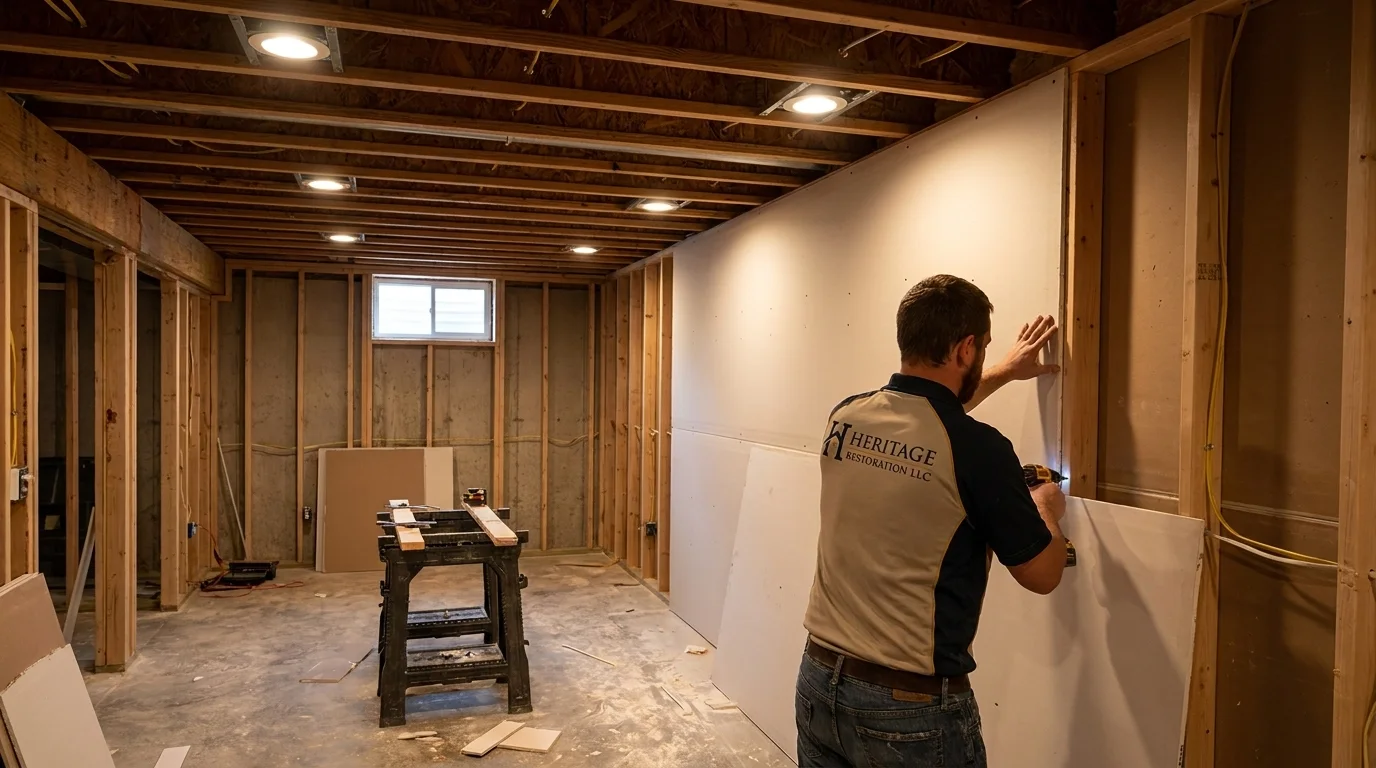
Basement Remodeling in Little Falls
Basement remodeling in Little Falls and surrounding areas. IICRC-certified, insurance billing accepted. Call (320) 733-8868.
A basement that’s been patched, painted over, or left unfinished for years usually has a story underneath the surface: old moisture staining on the sill plate, a sump pump that runs louder than it should, framing that was never sealed against the concrete. Basement remodeling at Heritage Restoration starts by reading that story before we talk about flooring or drywall, because a basement finished over an unresolved moisture issue is a basement you’ll be fixing again in three years.
What Basement Remodeling actually involves
Basement remodeling covers everything from converting a damp, unfinished space into usable square footage to gutting and rebuilding a basement that was previously finished and damaged by a leak, a sewer backup, or years of slow seepage. The work typically includes moisture and vapor barrier assessment, framing and insulation suited to below-grade conditions, electrical and plumbing rough-in, drywall rated for basement use, flooring that tolerates concrete slab moisture, and finish carpentry. In homes built before the 1980s, that often means testing for lead paint on old trim or doors before any demolition begins, since disturbing it without the right containment creates a separate problem. Timelines run anywhere from two to eight weeks depending on scope: a simple refresh of an already-dry basement moves fast, while a remodel that follows water intrusion requires drying and remediation work before framing can start.
Our process
- Moisture and structural assessment. Before any design conversation, we check the slab, foundation walls, and sill plate for active or past moisture intrusion, and we test humidity levels against what’s typical for a healthy basement.
- Scope of work and written estimate. We document what needs to happen room by room, including any remediation, demolition, or structural correction, and put it in writing before a single wall comes down.
- Remediation or repair, if needed. If there’s active water damage, mold growth, or foundation cracking, that gets addressed and allowed to dry and stabilize before finish work begins. This step is where remodeling overlaps with our water and mold remediation work.
- Framing, rough-in, and insulation. Walls go up using materials suited to below-grade humidity: treated bottom plates, rigid or closed-cell insulation where appropriate, and vapor management that won’t trap moisture against finished surfaces.
- Finish work and final walkthrough. Drywall, flooring, trim, and fixtures go in last, and we walk the space with you before calling it done.
What separates a good basement remodel from a bad one
The most common mistake in basement remodeling isn’t a design choice, it’s sequencing. Framing and drywalling over a basement that still has elevated moisture in the slab or foundation wall is how mold ends up growing behind finished walls within a season. A good remodel tests moisture levels before enclosing anything and uses materials, like rigid foam insulation and mold-resistant drywall, that tolerate the humidity swings a below-grade space naturally sees. Insurance adjusters, when a remodel follows a covered water loss, look closely at whether drying was verified and documented before reconstruction started; skipping that step is one of the fastest ways a claim gets disputed later. Another frequent shortcut is ignoring the sump pump and drainage system during the remodel itself, finishing around a system that’s undersized or failing instead of addressing it while the walls are still open.
What does Basement Remodeling cost?
Costs vary widely based on square footage, whether moisture issues need to be corrected first, and how finished the final space needs to be. Every basement is different, which is why Heritage Restoration provides a written scope of work with itemized pricing before any work begins. If the remodel is tied to a covered water or sewage loss, homeowners insurance may cover the remediation and repair portion, though the finish-level upgrades (like converting unfinished space into a bedroom) are typically treated as a separate, uncovered improvement.
| Scenario | Typical range |
|---|---|
| Basic refresh of an already-dry basement (paint, flooring) | $3,000 - $8,000 |
| Full finish of unfinished basement (framing to drywall) | $15,000 - $35,000 |
| Remodel following water damage (remediation + rebuild) | $8,000 - $25,000 |
| Basement bathroom addition | $6,000 - $16,000 |
| Egress window and framing for a legal bedroom | $4,000 - $9,000 |
Seasonal & regional considerations
Little Falls sits along the Mississippi River, and many homes in the area have block or poured foundations that were built decades before modern vapor barrier standards existed. Spring snowmelt and heavy rain can push groundwater levels up enough to reveal a slow seep that wasn’t obvious in drier months, which is why we recommend scheduling moisture testing in spring before committing to a finish timeline. Freeze-thaw cycles through a Minnesota winter also stress foundation walls, so any hairline cracking should be evaluated before it’s covered with drywall.
Service area
We remodel basements throughout Little Falls and across Morrison County, including Pierz, Royalton, and Sartell. If your basement’s housing stock, soil, or drainage profile is different from what’s typical in town, we’ll walk the specifics with you during the assessment.
If your basement has a moisture history, old finishes you don’t trust, or just years of wasted square footage, start with a scope of work instead of a guess. Call (320) 733-8868 to schedule a basement assessment and get a written plan before anything gets torn out.
Frequently Asked Questions
Does homeowners insurance cover basement remodeling?
How do you know if a basement is dry enough to finish?
Can you remodel a basement that previously had mold?
Do I need a permit to finish my basement in Little Falls?
What's different about insulating a basement compared to an above-grade room?
Looking for the best basement remodeling company in Little Falls?
Heritage Restoration LLC provides licensed and insured basement remodeling in Little Falls, MN and the surrounding area, and has served local property owners since 2023. We answer calls 24/7 — call (320) 733-8868 for immediate help.
Need Basement Remodeling now?
We respond 24/7 across Little Falls and surrounding MN cities.
Related Coverage
- Our Restoration Services
- Contact Heritage Restoration LLC
- Restoration Services in Albany
- Restoration Services in Avon
- Restoration Services in Baxter
- Restoration Services in Brainerd
- Restoration Services in Elmdale
- Restoration Services in Flensburg
- Restoration Services in Foley
- Restoration Services in Fort Ripley
- Restoration Services in Harding
- Restoration Services in Long Prairie
- Restoration Services in Pierz
- Restoration Services in Randall