
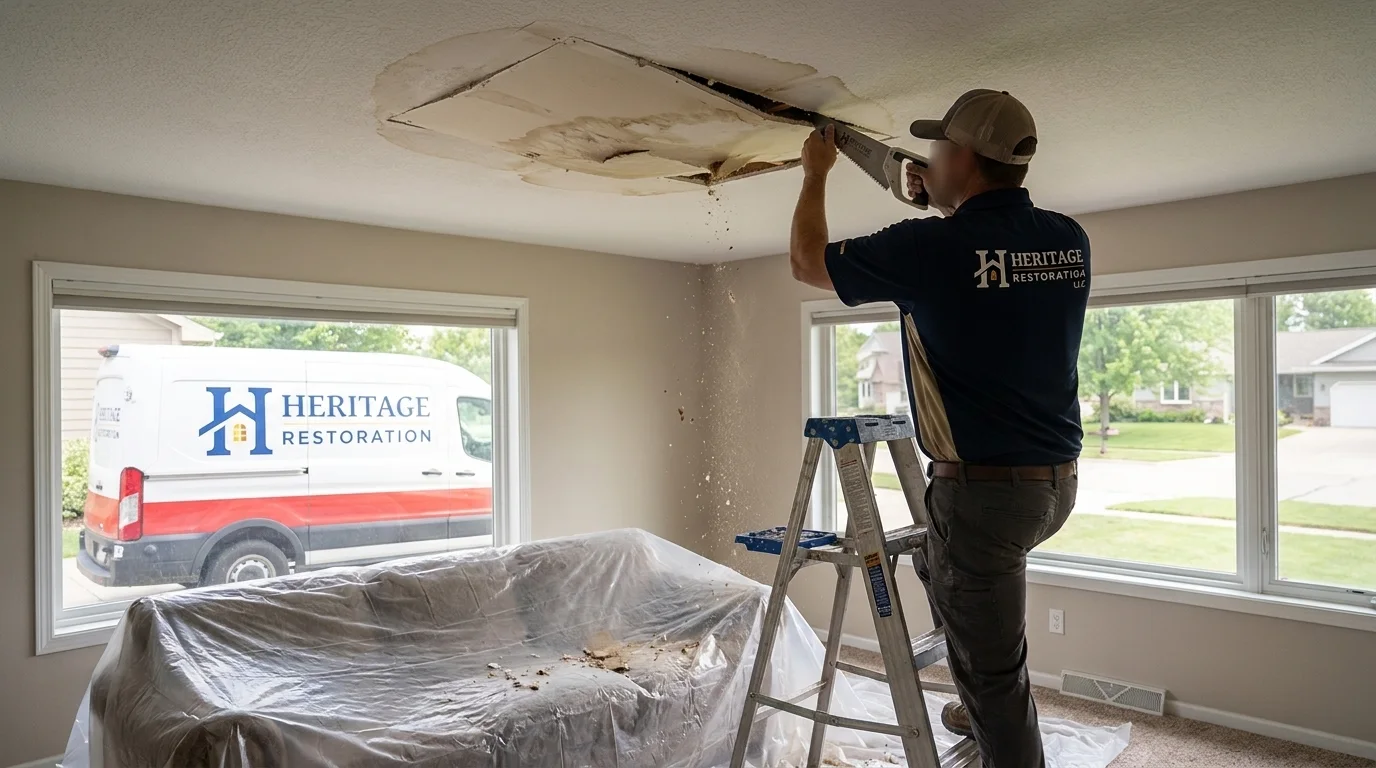
Emergency Ceiling Water Damage Repair in Little Falls
Emergency ceiling water damage repair in Little Falls and surrounding areas. IICRC-certified, insurance billing accepted. Call (320) 733-8868.
Water coming through the ceiling in Little Falls? Call now for emergency service. Our crew responds fast to stop the leak damage and start drying.
Water spreading across a ceiling or dripping through a light fixture means the damage is already past the drywall. A stain the size of a dinner plate today can mean saturated insulation, a soaked top plate, or a plumbing line still actively leaking above your head. Ceiling water damage repair addresses both the visible symptom and the hidden cause, because patching the drywall without finding the source just buys you a repeat problem in a few months.
What Ceiling Water Damage Repair actually involves
A leaking or stained ceiling is rarely a cosmetic job. Water travels along joists, pools at the low point of a ceiling cavity, and soaks drywall paper, insulation, and sometimes the subfloor of the room above before it ever shows on the surface. By the time you see a water stain ceiling or feel a soft, sagging spot overhead, the material behind it has usually been wet for hours or days.
The work typically involves locating the active or past source (a supply line, a roof penetration, a tub overflow, an HVAC condensate line), checking moisture content in the drywall, insulation, and framing with a moisture meter, and removing any material that’s lost structural integrity. Sagging drywall almost always has to come down; it will not re-adhere to the lath or joists once the paper facing delaminates. Drying equipment (air movers and, where the cavity is enclosed, dehumidification) runs for a few days to confirm the framing and any remaining insulation reach a dry standard before new drywall goes up, is taped, mudded, and textured to match.
Our process
- Source identification. Before any ceiling material is touched, we trace the water back to its origin, whether that’s a failed supply line, roof flashing, a clogged AC drain pan, or a bathroom above with a cracked tile grout line. Repairing the ceiling without stopping the source is a wasted repair.
- Moisture mapping. We use a moisture meter and, when needed, a thermal camera to trace how far the water traveled laterally through the ceiling cavity, since water rarely stays confined to the spot where it’s visible.
- Controlled demolition. Sagging, delaminated, or stained drywall is removed back to dry, sound material, not just the visibly damaged section, along with any wet insulation batts that have lost their R-value.
- Structural drying. Exposed joists and remaining framing are dried in place per IICRC S500 drying guidelines, with daily moisture checks until readings confirm the cavity is dry before closing it back up.
- Rebuild and finish. New drywall, tape, mud, texture match, and primer/paint bring the ceiling back to a pre-loss appearance, with insulation replaced to current coverage where it was removed.
What separates a good ceiling repair response from a bad one
The most common mistake is patching the stain without opening the ceiling to check how far the water traveled. A contractor who skims, primes, and paints over a water stain without checking moisture content behind it is sealing in a wet cavity, which sets up conditions for mold growth within 24 to 48 hours in warm, humid conditions.
A second common gap is ignoring electrical fixtures in or near the water path. Recessed lights, ceiling fans, and junction boxes that have had water running through or near them need to be checked before they’re re-energized, not just wiped down and reinstalled.
Insurance adjusters reviewing a ceiling water damage claim typically look for documented moisture readings before and after drying, photos of the removed material showing the extent of saturation, and a clear explanation of the source. Repairs without that documentation are more likely to get questioned or underpaid, which is why we build a written record as we go rather than reconstructing it after the fact.
What does Ceiling Water Damage Repair cost?
Costs vary with the size of the affected area, whether insulation and framing need replacement, and whether the ceiling has texture or detail that’s hard to match. Every loss is different, and Heritage Restoration LLC provides a written scope of work before any repair begins so there are no surprises once the ceiling is opened up. Homeowners insurance typically covers ceiling water damage when the cause is sudden and accidental, such as a burst pipe, though gradual leaks from long-term neglect are often excluded, which your adjuster will confirm based on the source.
| Scenario | Typical range |
|---|---|
| Small stain, no sagging, source already fixed | $350 - $900 |
| Localized drywall patch with insulation replacement | $800 - $2,200 |
| Sagging section requiring demo and rebuild, one room | $1,500 - $4,000 |
| Textured or vaulted ceiling with finish matching | $2,000 - $5,500 |
| Multiple rooms or whole-floor ceiling damage | $4,500 - $12,000+ |
Seasonal & regional considerations
In Little Falls, ceiling leaks spike twice a year: during spring thaw, when ice damming on roofs pushes meltwater back under shingles and into attic insulation above ceilings, and during deep winter cold snaps, when frozen or cracked supply lines in attics and exterior walls thaw and leak into the ceiling cavity below. Homes with older cast-iron or galvanized plumbing running through second-floor ceilings are also more prone to slow pinhole leaks that show up as a gradually spreading water stain ceiling rather than a sudden event.
Service area
We repair ceiling water damage for homeowners and property managers throughout Little Falls and the surrounding Morrison County communities, from older plaster-and-lath homes near downtown to newer drywall construction on the outskirts.
If you’re looking at a ceiling leaking, a fresh water stain, or a soft spot overhead that’s starting to sag, call Heritage Restoration LLC at (320) 733-8868 to schedule a ceiling moisture assessment before the damage spreads further into the structure.
Frequently Asked Questions
Does homeowners insurance cover ceiling water damage repair?
How do I know if a ceiling water stain means I need repairs now or can wait?
Why does a sagging ceiling need to be cut open instead of just patched?
How long does it take for mold to start growing in a wet ceiling cavity?
What should I do while waiting for a ceiling leak to be assessed?
Looking for the best ceiling water damage repair company in Little Falls?
Heritage Restoration LLC provides licensed and insured ceiling water damage repair in Little Falls, MN and the surrounding area, and has served local property owners since 2023. We answer calls 24/7 — call (320) 733-8868 for immediate help.
Need Ceiling Water Damage Repair now?
We respond 24/7 across Little Falls and surrounding MN cities.
Related Coverage
- Our Restoration Services
- Contact Heritage Restoration LLC
- Restoration Services in Albany
- Restoration Services in Avon
- Restoration Services in Baxter
- Restoration Services in Brainerd
- Restoration Services in Elmdale
- Restoration Services in Flensburg
- Restoration Services in Foley
- Restoration Services in Fort Ripley
- Restoration Services in Harding
- Restoration Services in Long Prairie
- Restoration Services in Pierz
- Restoration Services in Randall