
Emergency Water Removal & Cleanup in St. Stephen
emergency water removal and cleanup in St. Stephen, MN. IICRC-certified, insurance billing accepted. Call (320) 733-8868.
Our IICRC-certified technicians are dispatched from our Little Falls, MN headquarters and are typically on-site in St. Stephen within 60 minutes of your call.
Standing water emergency in St. Stephen? Call now for emergency service. Our crew responds fast to extract the water and start drying.
St. Stephen sits in Stearns County where the freeze-thaw cycle hits hard and fast, and when a pipe lets go or a sump pump fails during a spring thaw, water moves through a home quickly. The clay-heavy soils common across this part of central Minnesota drain slowly, which means groundwater pressure against basement walls can persist long after the rain or snowmelt stops. Getting water out fast is not just about the visible puddle on the floor; it is about stopping the clock on structural saturation and secondary damage before the problem compounds.
Why St. Stephen Properties Face Elevated Water Damage Risk
Stearns County’s climate delivers hard winters and rapid spring melt events that stress residential plumbing and drainage systems in equal measure. Homes in the St. Stephen area frequently have full basements, and those basements are the first place to feel the consequences when a sump pump is overwhelmed or a drain tile system backs up under saturated soil conditions.
Older construction in the region often features block foundation walls rather than poured concrete, and block foundations are more porous by nature. Water does not need a visible crack to migrate inward; it wicks through the mortar joints slowly and silently until there is standing water on the basement floor. By the time a homeowner notices, the subfloor above may already be absorbing moisture from below.
Well-water systems, common in rural Stearns County properties including those on the outskirts of St. Stephen, add another failure point: pressure tank malfunctions or supply line breaks can release a significant volume of water inside a mechanical room before the system is isolated.
Our Emergency Water Removal & Cleanup Process in St. Stephen
When Heritage Restoration LLC arrives at a St. Stephen property, the first priority is source control, confirming the water is no longer actively entering the structure before extraction begins. From there, the process follows a documented sequence calibrated to what central Minnesota homes actually look like.
Moisture mapping comes before any equipment placement. Thermal imaging and calibrated moisture meters identify where water has traveled behind walls, under flooring, and into insulation cavities that look dry at the surface. In homes with block foundations, that mapping extends to the wall cavities themselves, because block cores hold water in ways that standard drywall assemblies do not.
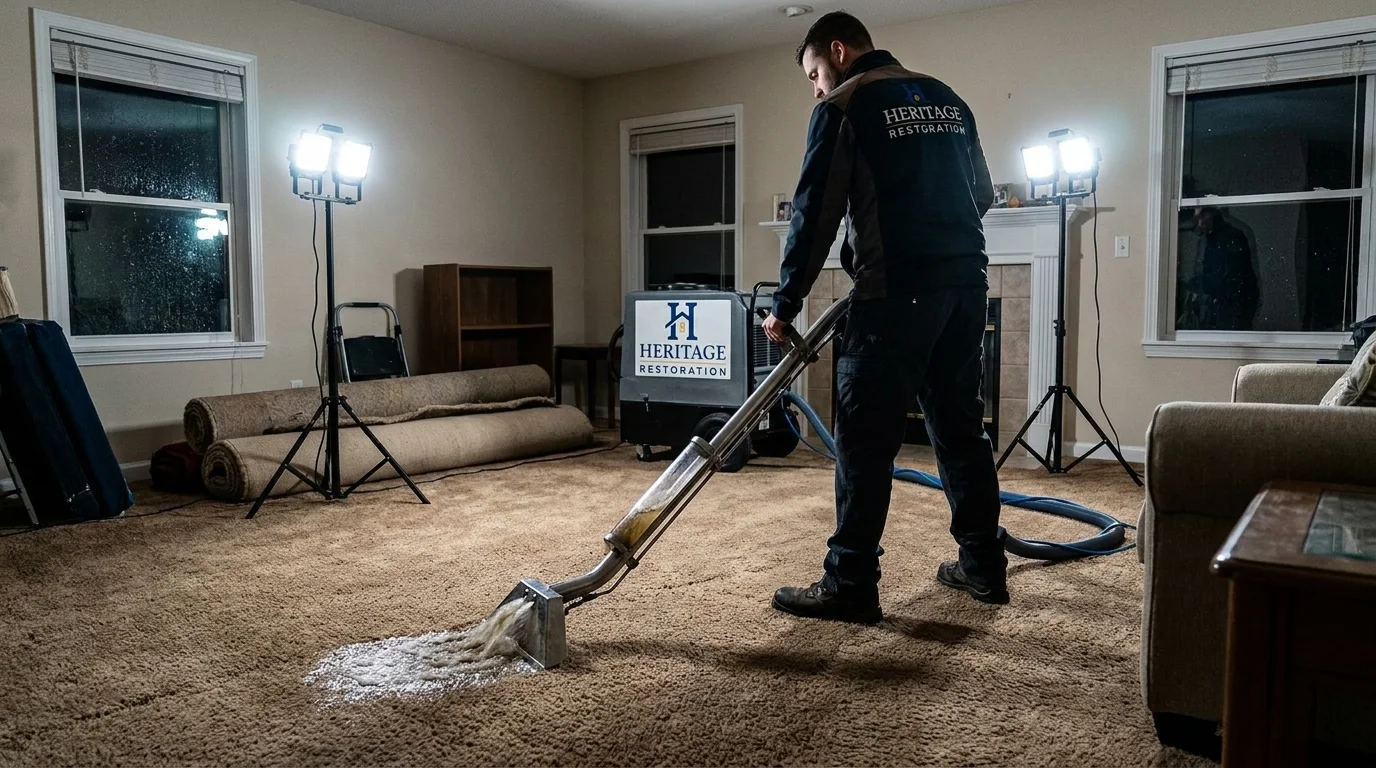
Extraction equipment removes standing water first. High-capacity truck-mount and portable extractors pull water from carpet, pad, and hard flooring before drying equipment is staged. Then industrial air movers and refrigerant or desiccant dehumidifiers are positioned based on the moisture map, not placed by guesswork. Drying is monitored against the IICRC S500 standard, with readings documented at each visit until affected materials reach acceptable moisture levels.
All documentation, including photos, moisture logs, and equipment records, is formatted to meet insurance carrier requirements from the first day on-site.
Reaching St. Stephen from Little Falls
Heritage Restoration LLC operates out of Little Falls, and St. Stephen is a straightforward drive south through Stearns County. The route via Minnesota State Highway 10 and connecting county roads keeps travel time manageable, which matters when water is sitting on a basement floor and every hour of contact time increases the risk of mold colonization, typically beginning within 24 to 48 hours on wet organic materials.
Call (320) 733-8868 to reach the team directly. Prompt scheduling is available, and the crew can confirm an estimated arrival window when you call so you are not waiting without information.
St. Stephen Insurance Coordination
Most homeowner policies cover sudden and accidental water discharge, which includes burst pipes, appliance failures, and certain sump pump failures depending on the policy rider. Heritage Restoration documents the loss in the format carriers expect: scope of damage, affected materials, moisture readings, and equipment logs. That documentation goes to your adjuster directly, reducing the back-and-forth that delays claim approval.
If your carrier requires a signed authorization or a preferred-vendor form before work begins, the team walks through that paperwork on arrival so it does not slow down extraction.
Local Note
In the St. Stephen area and across rural Stearns County, many homes rely on forced-air heating systems with ductwork running through the basement or crawl space. When a basement floods, that ductwork sits in the water or directly above it, and the interior of the ducts can accumulate moisture and debris even if the exterior looks undamaged. Restoration crews who work primarily in urban markets sometimes overlook duct interiors as a secondary moisture pathway. In central Minnesota homes where the furnace is the primary heat source through a long winter, confirming the duct system is dry and uncontaminated is part of a complete emergency water removal and cleanup, not an optional add-on.
Emergency Water Removal & Cleanup in St. Stephen: Service Coverage
Frequently Asked Questions
How fast can you arrive for emergency water removal & cleanup in St. Stephen?
How quickly can Heritage Restoration reach St. Stephen from Little Falls for a water emergency?
Does the clay-heavy soil common around St. Stephen affect how long water removal and cleanup takes?
Are block-foundation basements in the St. Stephen area harder to dry than poured concrete?
What does Heritage Restoration document for an insurance claim after a water loss in St. Stephen?
What certifications does the Heritage Restoration team hold for emergency water removal and cleanup work?
Emergency Water Removal & Cleanup response in St. Stephen
Most St. Stephen calls see a technician on-site within 60 minutes from our Little Falls headquarters.