
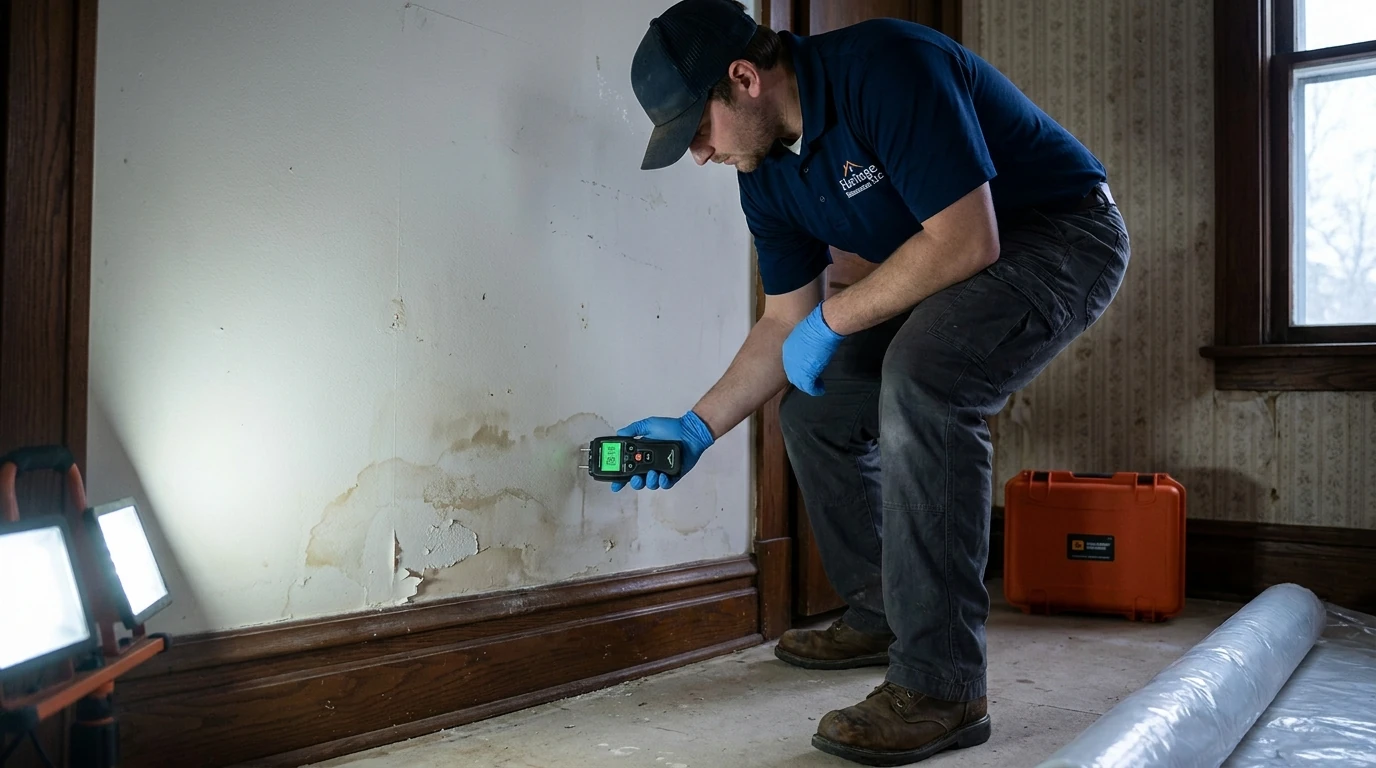
TL;DR: Water damage hides behind drywall long before it shows on the surface. Look for discoloration or a yellow-brown ring, bubbling or peeling paint, warped baseboards or door trim, a musty smell, a jump in your water bill, soft or spongy drywall, and cold or damp spots on an otherwise dry wall. Any two of these together mean it’s time for a moisture reading, not a guess.
If you’ve noticed a faint musty smell in a downstairs bedroom, or a baseboard that’s started to cup along one of the older river-facing homes near downtown Little Falls, you’re probably wondering whether it’s nothing or something. Minnesota’s freeze-thaw cycle and the plumbing in many of the century-old homes near the Mississippi make slow leaks common here, and slow leaks are exactly the kind that hide behind a wall for weeks before anyone notices a stain. The good news: there are specific, checkable signs that tell you which situation you’re in.
What are the first signs of water damage behind drywall?
The clearest signs are visual before they’re structural: staining, bubbling paint, and warped trim show up before the drywall itself fails. Catching them early is what keeps a $400 drying job from becoming a $4,000 wall replacement.
Work through this list room by room, especially along exterior walls, under windows, and near any wall that backs up to a bathroom, kitchen, or laundry hookup:
- Staining or a yellow-brown ring on drywall or ceiling, even faint
- Bubbling or peeling paint, which means moisture is pushing between the paint film and the drywall paper
- Warped or cupped baseboards and door trim, wood that’s absorbed water swells unevenly
- A musty, earthy smell that doesn’t clear with an open window
- An unexplained jump in your water bill with no obvious new use
- Soft or spongy drywall when you press it, healthy drywall doesn’t give
- Cold or clammy spots on a wall that should feel the same temperature as the rest of the room
One sign alone might be nothing. Two or more together, especially paired with a smell, is worth a professional moisture check before you patch or paint over it.
Why do I smell a musty odor but see no visible water damage?
A musty smell with no visible stain almost always means moisture is trapped inside the wall cavity, not on its surface. Drywall paper and the wood framing behind it absorb water long before it’s saturated enough to show through paint.
That smell is usually microbial volatile organic compounds, byproducts of mold or bacteria growing on wet building materials, according to the EPA’s guidance on mold. Mold can begin colonizing damp drywall within 24 to 48 hours of sustained moisture exposure. It doesn’t need standing water, just consistent dampness behind an insulated wall where air doesn’t circulate.
This is common in older Little Falls homes built with plaster-and-lath construction before drywall became standard, since plaster holds moisture differently and can mask a leak longer. It’s also common in newer homes where a slow supply-line drip behind a bathroom wall goes unnoticed because it never reaches the floor. If you want to understand what that timeline looks like once moisture is confirmed, we’ve written more on how quickly mold grows after water damage.
How do professionals check for moisture behind walls without cutting into them?
A moisture meter and a thermal imaging camera let a technician map wet areas behind an intact wall in a few minutes, without a single drywall cut. Between the two tools, they can tell you how wet the material is and how far the moisture has traveled.
A pinless moisture meter reads moisture content through the drywall surface using electrical impedance, giving a percentage reading that tells you whether the material is dry, at-risk, or saturated. A pin-style meter goes a step further by measuring at a specific depth when a more precise reading is needed. Neither leaves a mark you’d notice.
A thermal imaging camera doesn’t measure moisture directly. It reads surface temperature differences, and wet building material holds a different thermal signature than dry material around it, which shows up as a visible patch on the camera. Technicians trained under the IICRC S500 water damage restoration standard use thermal imaging to find the full boundary of a wet area first, then confirm and measure it with a moisture meter. That combination is what separates a guess from a documented moisture map, and it’s the same documentation an insurance adjuster wants to see before approving drying work.
A visual check alone misses all of this. You can only see moisture once it’s saturated enough to bleed through paint or paper, by which point it’s often been sitting for a week or more.
What should I do if I suspect hidden water damage in my Little Falls home?
Start with a professional moisture assessment before you patch, paint, or ignore it. Guessing wrong in either direction, over-repairing a dry wall or under-treating a wet one, costs more than the fifteen minutes a moisture reading takes.
Document what you’re seeing first: photograph any staining, note the smell, note when your water bill changed. Then schedule a moisture inspection so a technician can map the affected area with a meter and thermal camera before deciding whether it’s a spot-dry, a full wall opening, or something bigger. If the source is an active leak, get it stopped (shut off the fixture or the main) before the assessment, since a moisture map only tells you today’s picture.
If the reading confirms elevated moisture, structural drying with air movers and a dehumidifier, set up under the IICRC S500 standard, is usually faster and cheaper than tearing out and replacing wet drywall, provided the moisture is caught before the material has broken down. Heritage Restoration LLC can walk you through that decision with an actual moisture reading in hand, not a guess from the hallway.
A hidden leak doesn’t announce itself loudly. It shows up as a smell, a soft spot, a slightly warped baseboard, small things easy to explain away. Trusting those small signs, and getting a real moisture reading instead of waiting for a visible stain, is what keeps a slow leak from becoming a gutted wall.
About Heritage Restoration LLC
Heritage Restoration LLC is an IICRC-certified firm (WRT, ASD) serving Little Falls, Minnesota and the surrounding St. Cloud and Brainerd Lakes area since 2023 (license BC807677). Their crews handle water damage restoration, water cleanup, burst pipe repair, basement flooding cleanup, and structural drying for homes throughout central Minnesota.